Wednesday, November 26, 2014

Holy Shit, Turkeys!

Turkeys.

I'm gonna make this short because I have been distracted recently by the birth of my newest niece. That guy up above, as you probably know, is a Turkey. Despite being thoroughly American, he's named after Turkey the country. The reasoning behind this is that it sounds exotic, and the European explorers who found him may have still been under the impression that America was part of Asia.

Strangely enough, many other languages use country names for the turkey as well. In actual Turkey, they call it a "Hindi," suggesting that it's from India. That's surprisingly common. France, Ukraine, Poland, Russia, and several other countries also call it some variation of "India." In actual India, they call it a Peru.

In Cambodia, they call it a French Chicken. In Arabic, it's called either a Roman Chicken or an Ethiopian Chicken. In Malaysia, it's a Dutch Chicken.

Bottom line: Turkeys are weird, people's names for Turkeys are weirder, and Happy Thanksgiving.

Wednesday, November 19, 2014

Holy Shit, Senses!

Still Life by Pieter Claesz
Senses! Everyone knows we have five of them, right? Sight, Hearing, Taste, Touch, and Smell. We all learned that in Kindergarten, so why bother writing a whole blog post about it?

Well, one good reason is that we all learned wrong. There are more than five senses. I mean, it's not even close. There's not really a consensus on the exact number, either. The number doesn't really matter. Think of it like individual parts of your body. How do you define a "part?" Is your forearm a different "part" than your whole arm?
George Foreman Grill
And where does your Foreman come into play?
That's how it is with sense. You've got your traditional senses, which the Elizabethans called the "Five Wits" (incidentally, that's where the phrase "keep your wits about you" comes from). Then you have things like thermoception. That's your ability to detect temperature. You could argue that it's part of your sense of touch, but when you shiver, is it really a response to touching something cold?

Then there's proprioception. That's your sense of where your body is. It's another one that's either ignored or thrown in with touch. We can demonstrate the issue with that by performing a ten second experiment. Put your hand behind your head. You can't see it. You can't feel it. But you know where your hand is. You know what it's doing. That's your kinesthetic sense, otherwise known as "proprioception." It's what lets you touch your nose with your finger even when you close your eyes.
Field Sobriety Test
Uh...you know...in most cases.
How about your sense of balance? Can't really call that one touch, can you? It's based in your inner ear, and I don't think anyone would argue that it's part of hearing, either. But you can stand on thin surface and innately know when you're beginning to tilt too far in any direction.

There are tons of sense that you use all the time without thinking about it. Knowing when you need to breathe, knowing when you need to empty your little bladder or evacuate your bowels, feeling the urge to vomit, and even recognizing the passage of time are all senses beyond the traditional five.

If that's not enough to get you excited, think of it this way: most people want to experience the world in ways they never could before. One way to do that is by consciously recognizing what our bodies are automatically doing for us. When you acknowledge that you know where your hand is because of a sense you never knew you had, you're paving a conscious road where there was once only a subconscious dirt path.
Road Roller
See, the road roller is a metaphor for thinking.
And isn't that cool?

Holy shit.

Wednesday, November 12, 2014

Holy Shit, the Cuban Missile Crisis!

Kennedy and McNamara
About a year and half ago, I shared the story of Stanislav Petrov, the Soviet Air Defense officer who saved the world by neglecting his duty...because at that moment his duty was to start a nuclear war. It may or may not surprise you to learn that, in the almost half-century time period where there was a terrifying standoff between nuclear powers, that wasn't the only time someone almost pushed the big red button.

In fact, there was one situation that was arguably a closer brush with the proverbial Midnight. That one you probably remember reading about. It involved Cuba. And missiles. And a crisis.
U2 Spyplane photos of the Cuban Missiles
And aerial reconnaissance photos that mean nothing to the untrained eye

The Cuban Missile Crisis started because Fidel Castro was sick of the CIA trying to topple his fledgling Communist nation, and Nikita Kruschev wanted to make the U.S. sweat. See, the so-called "missile gap" was an actual thing. But it was a thing that almost comically favored America. The Soviet Union really didn't even have the capability to strike most of the United States from a distance, whereas the United States had both a wealth of ICBMs and missile sites in Turkey, close enough to nuke the baldness off of the Soviet Premier.

So Kruschev sent some nukes to Cuba. When the U.S. noticed, the world started to figuratively explode with the fear that it would soon literally explode. The U.S. Joint Chiefs of Staff unanimously advised President Kennedy to invade Cuba. Let that sink in. Such a decision would absolutely, unequivocally guarantee that the U.S.S.R. would, at the very least, invade West Berlin. And that action would almost as certainly lead to a nuclear reprisal from NATO.
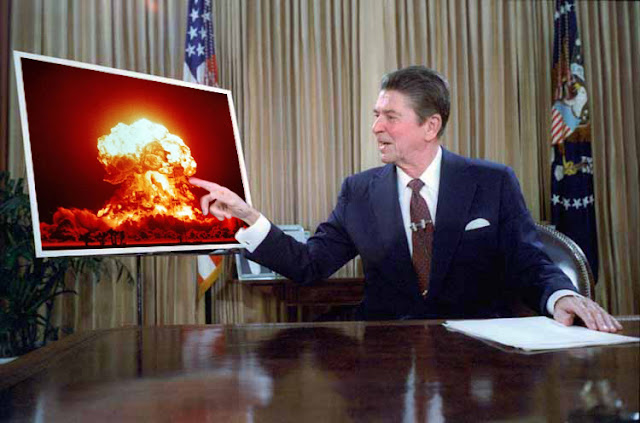
Reagan pointing at a nuclear explosion
Shit. Is. On. Fire.

In short, the U.S. Joint Chiefs of Staff were, with one voice, telling Kennedy that it was time to end the world. Kennedy thought maybe we should try a few other solutions first. The compromise was a naval "quarantine," which is like a blockade but you get to not use the word "blockade," because that's defined as an act of war by international law.

At some point, the ships of this blockade announced that they would be dropping practice depth charges on Soviet submarines. They weren't powerful enough to cause severe damage, but they would usually force a submarine to surface, negating its stealthy advantage. Somehow, the Soviet Foxtrot-class submarine B-59 didn't get the memo.
Message in a Bottle
I choose to believe it was the result of outdated communication methods.

When the depth charges hit, everyone aboard was under the impression that the Cuban Missile Crisis - and by extension, the Cold War - had just gone hot. That's where Vasili Arkhipov comes in. He was second-in-command on B-59, and he was one of three officers upon whose shoulders fell the decision of whether to fire a nuclear torpedo. The two other officers voted an emphatic "YES."

Arkhipov, thankfully, said "Well, I don't know." If he hadn't been a hero from a previous incident involving a nuclear accident at sea, his words may have been drowned out. But he stood his ground, and he had a reputation for being heard. B-59 surfaced, and Moscow informed them of the situation. The very next day, Kruschev announced that the missile sites were being removed, in exchange for assurances that the U.S. would not invade Cuba and, secretly, the removal of missile sites from Turkey.
Turkey
I mean, where were we even keeping them?

It's easy to think of the Cold War as a distant memory now. As a foregone conclusion. But we should remind ourselves once in a while that there were multiple occasions where a single voice of reason made the difference between continued detente and global annihilation. The Cold War was a game of Russian Roulette, and the Cuban Missile Crisis was the closest we ever came to pulling the trigger at the wrong time.

Holy Shit.

Wednesday, November 5, 2014

Holy Shit, Onfim!

Onfim 199

Remember when you were a kid, and you would fidget in all your classes and make weird doodles in your notebooks? Maybe you even still do it. It's a pretty common form of expression, usually reserved for when you can only spare about half your attention.

Onfim was a kid from Novgorod, Russia who doodled a lot. By itself, that doesn't mean much. But when Onfim was a student, Novgorod wasn't in Russia. It was the administrative center of the Novgorod Republic, which hasn't existed since 1478.
Novgorod Republic
I mean it was practically the size of Continental Europe. How am I just now learning about it?

We know about Onfim because he wrote his notes (and the aforementioned doodles) on soft birch bark. Before paper became a really big thing, birch bark was often used for that purpose. It's hearty and water-resistant, which is great for preservation since water is the mortal enemy of history.
Water
We'll beat you someday, water. You just wait.

Most of Onfim's writing involved practicing the Old Slavic alphabet and writing Psalms. The doodles, though, were likely not part of any assignment. He sketched portraits of himself, his friends, and his tutor. He drew fanciful monsters with arrows sticking out of them. He even drew pictures of knights in battle. I'm not sure which of those is the 13th Century equivalent of the Bond-Villain's-Underground-Bunker that every boy knows how to draw today, but I'm sure it's in there somewhere.
Onfim's sketches
I'm sure I've done something similar to this with helicopters instead of horses.

The great thing about Onfim is that he puts a human face on history. Not just a human face, but a face we all know. Because everybody doodles in school, and thanks to Onfim we know that we share that subtle desire to express ourselves with our ancestors going back at least 800 years.

Holy Shit.

Wednesday, October 29, 2014

Holy Shit, the Third Punic War!

Ruins of Carthage
 The Third Punic War started in 149 BC, and by 146 BC, Cato the Elder saw his dream of a dead Carthage fulfilled. If you were a Carthaginian at the time, the whole thing was just...such bullshit. You're sitting here in your utterly defeated country, doing whatever the Romans tell you to do because they could burn you and everything you love as easily as you could punch a rock.
Balancing Rock
Not that I'd recommend it. Rocks just aren't very good at dodging.

Then some foreign tribes started raiding Carthaginian territory. Carthage was bound by treaty to arbitrate all conflicts through the Roman Senate, but at this point they had paid off the war indemnity and considered the treaty dissolved. The Romans saw things differently.

More importantly, the Romans were facing a huge increase in population and a huge staying-the-same of farm yields. So the Third Punic War, essentially, was Rome looking at Carthage and saying, "Hey, guys, we need your food...so..." then lighting North Africa on fire.
Tunisian Painting
Not the farms, though. Boy, would that have ever been awkward!

Carthage was destroyed. Utterly. It's buildings were burned and its people put to the sword or sold into slavery. Its territories were annexed by Rome, and the city itself would only be rebuilt (as a Roman city) a century later. Then it became a Vandal Kingdom for a while until it was conquered by an Islamic Caliphate.

But here's the thing: when you completely obliterate a city, there's no one around to sign a peace treaty. In a weird but arguably (technically) legal way, the cities of Rome and Carthage remained at war after Carthage ceased to be part of the Empire. At least, that's how officials from both cities saw it in 1985, when the mayors of both cities signed a peace treaty and symbolic declaration of friendship.

If you take that technicality at face value, the Third Punic War was the longest conflict in history, lasting over 2,130 years.

Holy shit.

Wednesday, October 22, 2014

Holy Shit, The Cretaceous Coast!

Early Cretaceous Eath

We've got an election coming up in the United States. It's a midterm, which too many voters tend to think of like a bye week, but it's important. Go vote on November 4.

When you do, think about all the factors beyond your control that lead to the outcome of an election. Sometimes it's something stupid one of the candidates said or did to shoot themselves in the foot. Sometimes it's a wave of backlash against a single policy. And sometimes it's a 100-million-year-old geographic feature that used to be where you live.
Wait What?
I really hope some of you made this exact face.

That's the case for people living on the Cretaceous Coast, anyway. The Cretaceous Coast is, for the most part, a decidedly non-coastal region that stretches from Mississippi to the Carolinas. It's not easily distinguished on a modern topographical map, but in the Cretaceous Period it looked like this:
Late Cretaceous North America
This looks different from the one at the top of this post because they are millions of years apart
Pretty easy to see right? Well, you can also see it on a county-based electoral map, like this one from 2012:
Seriously though, look back and forth. It's eerie.

Now, I know what you're thinking. "Correlation isn't the same as causation, dummy," you sneer smugly as you sip your venti pumpkin spice latte and pat yourself on the back. Ordinarily, I'd agree with you. But not today. Today you're going to spit that pumpkin spice right back out onto your keyboard, you pretentious hipster. Because the Cretaceous Coast is demonstrably responsible for that strip of blue counties in the South.

Here's how it works: between 129 and 65 million years ago, the Cretaceous Coast was, in fact, a coast. That meant it was a hotbed of aquatic life, like plankton. When the water started receding, that life stayed behind and died, leaving a massive deposit of organic material. If you know anything about agriculture (and why wouldn't you in this day and age?), you know that organic material leads to ideal growing conditions for crops.
Human Reaper Larva
It can also be used to generate a representative of your race while all the actual humans are systematically destroyed.
Fast forward about 64,999,800 years to the early 1800s, and you've got yourself an agrarian, slave-based economy with nutrient-rich soil and an unprecedented boom in a cash crop (cotton) thanks to new industrial advances. The former Cretaceous Coast was primo real estate for plantation owners because it had some of the most hospitable soil on Earth for the humble cotton plant.

Not so hospitable for human rights, though
Now, I don't know if you were aware of this, but a lot of that cotton was actually picked by slaves. And at the time, chattel slavery was an institution that consisted almost entirely of white owners and black slaves. After the Civil War brought slavery to an end, most of those black slaves stayed where they were. Their families were there, and the only work many of them knew was there as well...and this time, they'd get paid to do it.

Eventually, those former slaves gained the right to vote. Some time later, they gained the actual ability to vote without being turned away at the polls or simply lynched for trying. Certain events transpired and certain party platforms were adopted, too complicated to go into here, that led to black voters almost universally voting for democrats in every election.

And that's how a geologic feature that hasn't been around since the dinosaurs continues to affect the political landscape of the American south to this very day.

Holy Shit.

And seriously, vote.

Wednesday, October 15, 2014

Holy Shit, Gamergate!

ESRB M Rating
If only.
For as long as I can remember, "gamer" has been one of the main points of my identity. Gaming was a constant companion for most of my youth. Several of my strongest and most enduring friendships were formulated on the foundation of shared interest in games. Games were a comfort and a release when I was a morose teenager.

Recently, I've started to shy away from calling myself a gamer. There are several reasons for the change. I have newer, more important ways to identify myself these days -- like husband, and more recently, father. But it's not like I don't still play. I do. Every chance I get, even if said chances are few and far between.

The bigger reason is Gamergate. Gamergate is a movement that is ostensibly about corruption in the games journalism industry. That's a very real problem. There have been instances of journalists being fired for writing honest reviews of games whose publishers were providing advertising revenue to the host site. That is all kinds of unethical, and it's not an isolated problem.
Giant Bomb
But we got these guys out of it. They're cool I guess.

But that's not what sparked Gamergate. Gamergate started when the jilted ex-boyfriend of an indie game developer posted a video manifesto that aired all of their dirty laundry, including accusations that she had cheated on him and exchanged sexual favors for positive coverage of her game. The Internet exploded in the way it only does when there's a new woman to harass. Of all people, Adam "Jayne from Firefly" Baldwin coined the movement's title...in the midst of one of his bat-shit, right-wing Twitter rants. 
BUT OBAMA WANTS EBOLA AND WOMEN ARE SOMETIMES LESS HAVING SEX WITH ME THAN I'D LIKE
Jayne, your mouth is talking. You might want to look to that.

It could have been a decent movement, to be honest. But from its inception, the people who were saying, "If that's true, it really says something about the state of games journalism" were instantly drowned out by the hordes of ignorant shits screaming, "It must be true! What reason would a jilted ex-boyfriend have to lie about his ex-girlfriend to her peers? Our only reasonable course is to threaten to rape and murder her."
They're like this, but with death threats.
And I am not fucking kidding about that. Zoe Quinn was driven from her home by threats of sexual violence and death, from people who had found and published all of her personal information, including her address. Anyone of any standing in the industry who spoke in her defense was given the same treatment, including Anita Sarkeesian, a feminist critic who had already seen her share of death threats because of her video series that asks the question, "Do the games industry and gaming culture maybe treat women poorly?"
Threats against Anita Sarkeesian
GEE I WONDER

The movement is completely out of control at this point, and it might be the biggest threat to gaming since the industry crashed in 1983. A largely falsified rumor about a woman's sex life has started a horrific campaign of harassment against women who are interested in games and want them to be a more inclusive medium. I mean, Jesus Christ, when I was a teenager my heart would have burst with joy if I learned that games were considered "art" enough where they could be subject to feminist critiques. I've always insisted that video games could be more than toys, and now that people outside of the traditional gaming demographic are acknowledging that, a bunch of children are trying to drive them away with death threats.

So as much as I'm not done with gaming, I'm done being a gamer. I know from the responses within the industry to Anita Sarkeesian and to the Gamergate lunacy that I can look forward to a richer, more diverse culture surrounding games. But gamers? I won't be a part of that world anymore.

Holy shit.