Showing posts with label America. Show all posts

Tuesday, February 24, 2015

Holy Shit, Special Order 191!

On September 13, 1862, Barton Mitchell was moseying around a hilltop when he came across an envelope. Inside were three cigars wrapped in a single piece of paper. "Lucky me," Barton presumably thought as he unwrapped his prize, perhaps assuming the paper was a birthday card or something.

But then he saw the writing. It wasn't a pithy, jejune greeting. It was a thoroughly detailed ten point list...of orders. Confederate orders. Not just any Confederate orders, either. They were explicit movement orders for every high-ranking officer in the Army of Northern Virginia. And Barton Mitchell just happened to be a Union soldier. Naturally, he slackened his jaw, allowing the cigar to fall dramatically to the grass. Probably.
The Scream
Artist's Rendition
Then he took the orders directly to his commanding officer, who sent it up the chain, person by person, until it reached Major General George B. McClellan, who practically jumped for joy and said, "Here is a paper with which, if I cannot whip Bobby Lee, I will be willing to go home."

Two weeks later, largely thanks to the intelligence gleaned from Special Order 191, the Union won a strategic victory at the Battle of Antietam, which brought the Confederate offensive to a grinding halt and proved a significant enough turning point for Abraham Lincoln to deliver the Emancipation Proclamation. While the war had always been about slavery, the Emancipation Proclamation stated without question that freeing slaves in Confederate territory was now a strategic goal of the Union.
Lincoln and McClellan
Along with posing in a most dignified manner.
Arguably, the Civil War could have gone differently if Barton Mitchell hadn't stumbled upon such a valuable piece of information. In fact, there's a lengthy series of alternate history novels that base their point of divergence on that very event. The tiniest mishaps, like using the wrong paper to wrap your cigars and then leaving them behind, can be what Gandalf called "the falling of small stones that starts an avalanche in the mountains."
Gandalf from The Two Towers
He would actually fit in pretty well, given the facial hair.

Holy shit.


"LostOrdersCramptonsGap112611" by Wilson44691 - Own work. Licensed under CC BY-SA 3.0 via Wikimedia Commons

"The Scream" by Edvard Munch

"Lincoln and McClellan 1862-10-03" by Alexander Gardner - This image is available from the United States Library of Congress's Prints and Photographs division under the digital ID cwpb.04351.

The Two Towers still by New Line Cinema. Licensed under Fair use via Wikipedia

Wednesday, December 24, 2014

Holy Shit, NORAD!

Sears ad that got NORAD to track Santa

I've had this one in mind all year, specifically for today. Then NPR went ahead and did a story on it last week. Thanks, NPR. Thanks a lot.

For the uncultured rabble who don't follow NPR, I guess I can still give it a go. Around this time of the year in 1955, a local branch of Sears in Colorado Springs put an ad in the papers. The ad promised kids that they could get a hold of Santa Claus himself by calling a certain phone number. There was a bit of a typo, and when little Timmy picked up the phone on Christmas Eve to talk to Santa, a gruff military voice was on the other line. That gruff military voice belonged to a confused staffer of CONAD, which would be reorganized a few years later into NORAD. Nobody without security clearance was supposed to have that number.

You know NORAD, right? It's the North American Aerospace Defense Command. Aside from being terrible with acronyms, it serves the purpose of keeping unwanted visitors out of North American airspace. Unwanted visitors like Air Force planes that belong to nations who dislike America and Canada. Unwanted visitors like nuclear weapons.
Nuclear explosion
Which is pretty high on my list of things I don't want in my airspace.
It's obviously pretty nice to have them around. You would expect them to be a no-nonsense outfit. Strictly business, right? Well, for the most part, they are. The officer in charge that night, Colonel Harry Shoup, had a soft spot for good little American boys and girls. Since the cat was pretty much out of the bag where the phone number was concerned, he issued a standing order: When a staffer answers the phone to hear a child asking about Santa Claus, they are to perform their regular duty and track the flying object in U.S. airspace. That is to say, our nation's first line of air defenses was ordered to track Santa Claus on Christmas Eve and share his location with the children.
NORAD Tracking Santa
Military Decorum.

The feeling in general about this incident within the armed forces was that it was adorable. Adorable, and a perfect opportunity for good publicity. What better way to connect with the people they protect than to indulge in their most innocent fantasies? So it became a Thing with a capital T. Every year since 1955, CONAD -- and then NORAD -- has tracked Santa Claus on Christmas Eve and shared his location with inquiring children. It's all on a volunteer basis now, and there's a hotline and website and everything.

Because who says the people who watch the skies for nuclear missiles can't also get into the Christmas spirit?
NORAD Tracks Santa logo
Even if they could do better with the logo...
Holy shit.

Also, happy holidays.

Wednesday, November 12, 2014

Holy Shit, the Cuban Missile Crisis!

Kennedy and McNamara
About a year and half ago, I shared the story of Stanislav Petrov, the Soviet Air Defense officer who saved the world by neglecting his duty...because at that moment his duty was to start a nuclear war. It may or may not surprise you to learn that, in the almost half-century time period where there was a terrifying standoff between nuclear powers, that wasn't the only time someone almost pushed the big red button.

In fact, there was one situation that was arguably a closer brush with the proverbial Midnight. That one you probably remember reading about. It involved Cuba. And missiles. And a crisis.
U2 Spyplane photos of the Cuban Missiles
And aerial reconnaissance photos that mean nothing to the untrained eye

The Cuban Missile Crisis started because Fidel Castro was sick of the CIA trying to topple his fledgling Communist nation, and Nikita Kruschev wanted to make the U.S. sweat. See, the so-called "missile gap" was an actual thing. But it was a thing that almost comically favored America. The Soviet Union really didn't even have the capability to strike most of the United States from a distance, whereas the United States had both a wealth of ICBMs and missile sites in Turkey, close enough to nuke the baldness off of the Soviet Premier.

So Kruschev sent some nukes to Cuba. When the U.S. noticed, the world started to figuratively explode with the fear that it would soon literally explode. The U.S. Joint Chiefs of Staff unanimously advised President Kennedy to invade Cuba. Let that sink in. Such a decision would absolutely, unequivocally guarantee that the U.S.S.R. would, at the very least, invade West Berlin. And that action would almost as certainly lead to a nuclear reprisal from NATO.
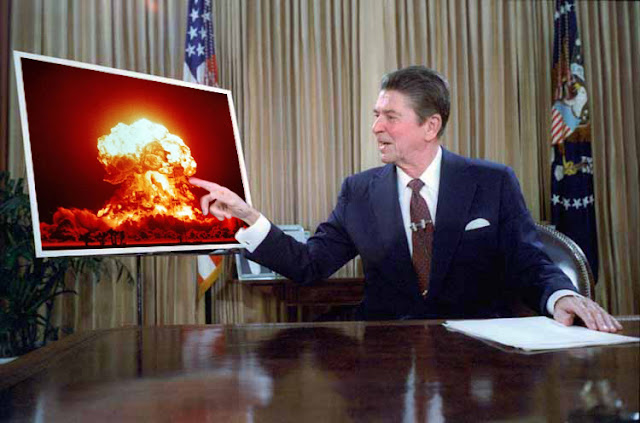
Reagan pointing at a nuclear explosion
Shit. Is. On. Fire.

In short, the U.S. Joint Chiefs of Staff were, with one voice, telling Kennedy that it was time to end the world. Kennedy thought maybe we should try a few other solutions first. The compromise was a naval "quarantine," which is like a blockade but you get to not use the word "blockade," because that's defined as an act of war by international law.

At some point, the ships of this blockade announced that they would be dropping practice depth charges on Soviet submarines. They weren't powerful enough to cause severe damage, but they would usually force a submarine to surface, negating its stealthy advantage. Somehow, the Soviet Foxtrot-class submarine B-59 didn't get the memo.
Message in a Bottle
I choose to believe it was the result of outdated communication methods.

When the depth charges hit, everyone aboard was under the impression that the Cuban Missile Crisis - and by extension, the Cold War - had just gone hot. That's where Vasili Arkhipov comes in. He was second-in-command on B-59, and he was one of three officers upon whose shoulders fell the decision of whether to fire a nuclear torpedo. The two other officers voted an emphatic "YES."

Arkhipov, thankfully, said "Well, I don't know." If he hadn't been a hero from a previous incident involving a nuclear accident at sea, his words may have been drowned out. But he stood his ground, and he had a reputation for being heard. B-59 surfaced, and Moscow informed them of the situation. The very next day, Kruschev announced that the missile sites were being removed, in exchange for assurances that the U.S. would not invade Cuba and, secretly, the removal of missile sites from Turkey.
Turkey
I mean, where were we even keeping them?

It's easy to think of the Cold War as a distant memory now. As a foregone conclusion. But we should remind ourselves once in a while that there were multiple occasions where a single voice of reason made the difference between continued detente and global annihilation. The Cold War was a game of Russian Roulette, and the Cuban Missile Crisis was the closest we ever came to pulling the trigger at the wrong time.

Holy Shit.

Wednesday, October 22, 2014

Holy Shit, The Cretaceous Coast!

Early Cretaceous Eath

We've got an election coming up in the United States. It's a midterm, which too many voters tend to think of like a bye week, but it's important. Go vote on November 4.

When you do, think about all the factors beyond your control that lead to the outcome of an election. Sometimes it's something stupid one of the candidates said or did to shoot themselves in the foot. Sometimes it's a wave of backlash against a single policy. And sometimes it's a 100-million-year-old geographic feature that used to be where you live.
Wait What?
I really hope some of you made this exact face.

That's the case for people living on the Cretaceous Coast, anyway. The Cretaceous Coast is, for the most part, a decidedly non-coastal region that stretches from Mississippi to the Carolinas. It's not easily distinguished on a modern topographical map, but in the Cretaceous Period it looked like this:
Late Cretaceous North America
This looks different from the one at the top of this post because they are millions of years apart
Pretty easy to see right? Well, you can also see it on a county-based electoral map, like this one from 2012:
Seriously though, look back and forth. It's eerie.

Now, I know what you're thinking. "Correlation isn't the same as causation, dummy," you sneer smugly as you sip your venti pumpkin spice latte and pat yourself on the back. Ordinarily, I'd agree with you. But not today. Today you're going to spit that pumpkin spice right back out onto your keyboard, you pretentious hipster. Because the Cretaceous Coast is demonstrably responsible for that strip of blue counties in the South.

Here's how it works: between 129 and 65 million years ago, the Cretaceous Coast was, in fact, a coast. That meant it was a hotbed of aquatic life, like plankton. When the water started receding, that life stayed behind and died, leaving a massive deposit of organic material. If you know anything about agriculture (and why wouldn't you in this day and age?), you know that organic material leads to ideal growing conditions for crops.
Human Reaper Larva
It can also be used to generate a representative of your race while all the actual humans are systematically destroyed.
Fast forward about 64,999,800 years to the early 1800s, and you've got yourself an agrarian, slave-based economy with nutrient-rich soil and an unprecedented boom in a cash crop (cotton) thanks to new industrial advances. The former Cretaceous Coast was primo real estate for plantation owners because it had some of the most hospitable soil on Earth for the humble cotton plant.

Not so hospitable for human rights, though
Now, I don't know if you were aware of this, but a lot of that cotton was actually picked by slaves. And at the time, chattel slavery was an institution that consisted almost entirely of white owners and black slaves. After the Civil War brought slavery to an end, most of those black slaves stayed where they were. Their families were there, and the only work many of them knew was there as well...and this time, they'd get paid to do it.

Eventually, those former slaves gained the right to vote. Some time later, they gained the actual ability to vote without being turned away at the polls or simply lynched for trying. Certain events transpired and certain party platforms were adopted, too complicated to go into here, that led to black voters almost universally voting for democrats in every election.

And that's how a geologic feature that hasn't been around since the dinosaurs continues to affect the political landscape of the American south to this very day.

Holy Shit.

And seriously, vote.

Wednesday, September 10, 2014

Holy Shit, the Confederate Flag!

Battle Flag of the Army of Northern Virginia

See that flag up there? Everybody knows what that flag is, right? Yeah. And everybody is wrong.

There are basically two camps where the Stars and Bars are concerned, and neither of them get it quite right. There's a third camp, of course, that is the correct one. It's full of historians and obnoxious pedants with blogs.
Me
Not that I'm naming names or anything

The first and more heinously incorrect camp is the one that says "It's heritage, not hate." They may well believe it, just as they (often, not always) believe that the civil war was fought over states' rights and not slavery.

Trouble is, the Southern states were only interested in states' rights as far as the states were supporting the institution of slavery. If it was a straight "limit the federal government" thing, the South would not have been so eager to pass the Fugitive Slave Act, which forbade Free States from granting free passage to escaped slaves.
Fugitive Slave Act
Also, it was total bullshit.

Don't get me wrong. The North didn't go to war to free the slaves. The North wanted to ensure that future states admitted to the Union were Free States, which had a lot more to do with congressional representation than any moral crusade. Ultimately, the Civil War was about whether States were legally allowed to leave the Union.

And the answer was, "Not according to my friend Richard Gatling over here."
Gatling Gun
He has 200 friends per minute agreeing with him, too.

The other camp maintains that the flag at the top of this page is the flag of the Confederacy, a nation that came into existence, according to its founding members, so that the institution of slavery could continue. They get part of it right. But it's not the flag of the Confederacy. The flag at the top of this page is the flag of the Army of Northern Virginia. There were three flags of the Confederate States of America, and they are below:
Flags of the Confederacy

The fact that we remember one region's battle standard as the flag is indicative of one of the reasons the Union won the Civil War. We'd already tried a Confederacy under the Articles of Confederation. It turns out, having a strong, centralized government is good for encouraging you to fight a war with the whole country in mind rather than just one region.

Since the Army of Northern Virginia was Robert E. Lee's army, it tends to get all the attention. Thus, we have everyone thinking their battle standard was the flag of the whole short-lived country. As for the flag representing a rebellion based on the right to treat people as property...well, yeah. It pretty much is that. But only in part of one of the states. So that's something, I guess.

Holy shit.

Wednesday, June 18, 2014

Holy Shit, the Fasces!

Fasces
I'm doing something a little different this time. I'm going to give you a bit of background on this thing that you're seeing at the top of the post, then I'm going to tell you a story about something I saw when I was in Washington, D.C. that completely blew my mind. Sort of. I mean, it was more the fact that I picked up on it immediately that blew my mind. It was a seminal moment in my academic development that ultimately would lead me nowhere special. But hey, I've got a blog, right? So that's something.

Anyway, that thing is called a fasces. It's a bound bundle of birch rods with the head of an axe sticking out of it. It literally means power. It was the symbol of executive authority in Etruscan civilization. When the Romans took over, they adopted it as their own.
Abzorbaloff from Doctor Who
They took the Abzorbaloff approach to empire building

Here's how it worked: when a powerful official would stroll around their domain, they would be accompanied by subordinates called lictors. These lictors would carry around a fasces. The axe head would not always be a part of it - it was there to indicate that the official the lictors accompanied had the authority to mete out capital punishment. 

See, if a magistrate saw somebody being naughty, they could theoretically point at them and the lictors would be obliged to walk over and beat the fear of Jupiter into them. If they saw someone being really naughty, they could assign one of the lictors to the role of on-call executioner. The axe head was forbidden within the boundaries of Rome. Within the city, the power of life and death rested solely with the people. Well, you know, the rich ones. But putting a weapon on display was considered...in poor taste, at best. Treason, at worst.
Crucifixion of St. Peter by Caravaggio
They didn't exactly show leniency for treason, either

More importantly, the bundle of birch rods represented strength through unity. Alone, the rods could easily be broken over your knee. Tied together, they formed a cohesive, stronger unit that even Bane would have a bit of trouble getting through.
Bane breaking Batman
And he broke the Batman over his knee
Now, here's where the story comes in. I learned about the fasces in a high school Latin class, just weeks before I took a class trip to Washington, D.C. I don't know if you've noticed, but just about every important person in the history of the federal government has flashed some serious bedroom eyes toward Ancient Rome. So just about everything in our nation's capital pays lip service in some way toward Roman culture.

On the day we went to the Lincoln Memorial, I was able to put my new-found knowledge to use. Here's a picture of the statue of Abraham Lincoln that you'll find there:
Wait, that's not Daniel Day-Lewis

Notice anything familiar about it? Here's a hint: those aren't just armrests on his chair. He's got two old Roman symbols of magisterial authority under his arm. But there's more. These fasces have no axe head, because they're within the borders of the capital.

Lincoln presided over the country during the Civil War. What better symbol for his authority than one suggesting that strength comes from Union? One that conspicuously lacks a key element, which is only left out when it's in a place where people are forbidden from taking up arms against each other?

All this is basically to say that Daniel Chester French was the right man for the job of sculpting this memorial.

Holy shit.

Wednesday, May 14, 2014

Holy Shit, Flamethrowers!

Flamethrower in Vietnam
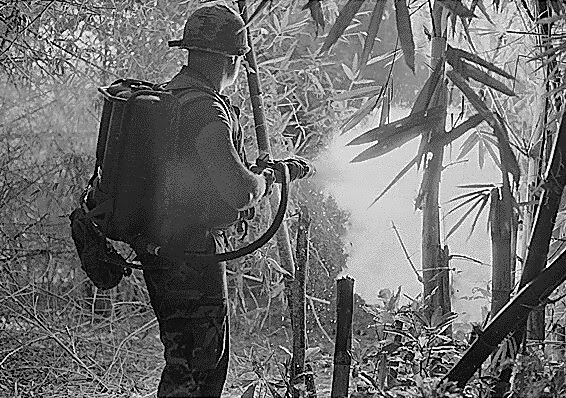
According to George Carlin “The very existence of flamethrowers proves that some time, somewhere, someone said to themselves, 'You know, I want to set those people over there on fire, but I'm just not close enough to get the job done.'” If you don't count the Byzantine Empire (and who does these days?), that someone was probably Richard Fiedler.

Fiedler submitted his designs for a man-portable horrific weapon that spits goddamn fire at people to the German army in 1901, and he called it the Flammenwerfer. What with being German and all. It was first used in combat in World War I, where it was used to cleverly employ man's subtle fear of dying horribly in a fiery inferno, making soldiers run out into the open. That was not such a good thing to do in Trench Warfare.
No Man's Land
They didn't call it "No Man's Land" because it was a ladies-only club.

They were used much more extensively in World War II, where both the Axis and the Allies learned that throwing fire into a building was actually a really handy trick for murdering everything inside. The U.S. found them particularly useful in the Pacific Theater, where they could belch the white hot fury of Hades into caves and thick vegetation, burning down the later and sucking all the oxygen out of the former. The only drawback was a mild concern that the person carrying the weapon was essentially an incendiary bomb at all times.

Man on fire
Which I guess is a pretty big deal to some people

As of 1978, the U.S. military stopped all use of flamethrowers in combat. It turns out they're not actually all that effective on the battlefield. At least, not effective enough to justify the public relations problem that results from causing horrific, burning, largely indiscriminate death. Not to worry, though! The flamethrower has more uses!

We'll start with the positive one. Remember how Smokey Bear was wrong about forest fires? Well, it turns out that the best way to do a controlled burn and prevent out-of-control wildfires involves flamethrowers. Neat, huh? It gets better!
Controlled Burn
Better than public works projects? Impossible!

In the good old United States of America, flamethrowers are almost completely unregulated on a federal level! In many states, you can either purchase or build your own flamethrower and use it for whatever purpose you want! Other than killing folks. We do have laws for that. But if you think a flamethrower is necessary for your personal protection against home invaders, you are within your rights to have one under your pillow. Criminals will regret ever breaking into your house. And your house will probably burn to the ground.

But that's nothing compared to what I see as the pinnacle of flame propelling technology. In South Africa, starting in 1998, car-mounted flamethrowers were available as a defensive measure against car jacking. Someone trying to break into your car? No problem! Set them on fire!
Car-mounted flamthrower
I'm not seeing any way this could go horribly wrong.

They've since discontinued that particular product line, so now South Africans have to settle for personal pocket flamethrowers for self defense. Which are available in stores. Over the counter.

Holy shit.

Wednesday, April 23, 2014

Holy Shit, the New Coke!

New Coke can

Let's say you're a soft drink manufacturer. In fact, you're the biggest soft drink manufacturer in the world. You're on top of the world for almost a century, keeping a huge majority of the market for yourself. Life is good. Then suddenly, one of your chief rivals decides to try a new markeitng thing and actually prove that people prefer Pepsi to your smelly old Coke in blind taste tests.

That's the position in which the Coca-Cola company found themselves in the late 1970s and early 1980s. Pepsi had introduced the "Pepsi Challenge," where random people would participate in blind taste tests and regularly choose Pepsi over Coke. It was a devastating blow to morale at poor, folksy old Coca-Cola, and the sales figures weren't helping. Between 1940 and 1980, Coca-Cola's market share dropped from a comfortable 60% to a terrifying 24%.

Coca-Cola is doing pretty well for themselves
Pictured is (one of the buildings at) their rickety old mom-and-pop multinational corporate headquarters

So they sprang into action. The President of Coca-Cola and the VP of Marketing developed a radical rebranding strategy that would involve not only introducing a new, sweeter version of the famous beverage, but discontinuing the original. Enormous amounts of money went into meticulously crafting the new formula and taste testing it against both Pepsi and the old Coke. They called it Project Kansas.

Kansas being boring
If there's a better name for a project that would ultimately fail to excite anyone in a positive way, I haven't heard it.

And it won. Big time. It was poised to be the new favorite drink of the entire world. In 1985, they gave the green light. All at once, Coca-Cola stopped selling their old drink and launched the New Coke. If you or anyone you know was alive and cognizant during the 1980s, you know what happened next: a complete, unmitigated, cluster-fucking disaster.
Hindenburg disaster
Coca-Cola, April of 1985

It's not that people didn't like the taste of the New Coke. Research showed they liked it better than anything. It just wasn't Coke, dammit. There were some initial successes, but the backlash was outrageous. Coca-Cola's hotline saw a 200% increase in calls, almost all of which were people talking about the old formula as though their favorite uncle had just died. Some were depressed. Some were angry. Some even threatened to sue. After three months of this, the company finally decided to relent. They announced that the classic recipe would be making a triumphant return. The news was so celebrated that it was brought up on the floor of the in-session United States Senate.
Ted "I don't know how filibusters work" Cruz
And that was the last time anyone did something pointless, misguided, and stupid on the Senate Floor

Here's the part where I prove myself wrong. I called the disaster "unmitigated," but the re-release of the original recipe was actually a massive mitigation. People were so relieved to have their familiar product back that Coca-Cola surged ahead in the market once again. After a few months (and, notably, the release of Cherry Coke), Coca-Cola enjoyed twice the sales as Pepsi.

Little by little, the company put New Coke behind them. Sales in the United States were discontinued shortly after Coca-Cola Classic came back. A few years later, the New Coke was more or less gone. Finally, in 2009, the "Classic" label was removed, and the last vestige of the massive failure turned enormous success was gone.

To sum up: Pepsi, to most people, simply tastes better than Coke. But taste is almost insignificant compared to the power of familiarity and nostalgia.

Holy shit.

Wednesday, February 19, 2014

Holy Shit, John D. Rockefeller!

John D. Rockefeller

Let's talk about wealth. You know how we like to use the phrase "filthy rich?" Well, if wealth is filth, then John D. Rockefeller could single-handedly destroy Captain Planet by the sheer weight of his putrescence.
Captain Planet vs. Hitler
Though to be fair, Hitler almost destroyed him with a rude glance.

The man was moneyed. Big time. You think you have a wealthy relative? Your cousin or uncle who started a business and owns a McMansion? Pah. Plebe. Rockefeller could buy most small cities if he had been so inclined. He could have swooped in on his hometown of Cleveland, for example, and bought every single building within the city limits. Probably. I didn't look that up, it just seemed right. Sue me.

You think Bill Gates has wealth? Well, he does. He is currently the richest man on the planet, valued at over 72 Billion Dollars. That's after he gave much of his fortune away to charity. But adjusted for inflation, Bill Gates did not have as much money as John D. Rockefeller. Not by a loooooooooooong shot. Adjusted for inflation, Rockefeller was worth about 665 Billion Dollars. More than NINE TIMES as much as Bill Gates.
Bill Gates frowning
Sorry, William.

You know how Occupy Wall Street took "We are the 99 percent" as their rallying cry? The "1%" in the time of Rockefeller...was Rockefeller. He was the sole member of the top 1% of wealth-holders in America. In fact, since he personally controlled 1.53% of the GDP of the United States, he could have legitimately claimed to be both a part of the 1% and joined in the chant, "We are the 99%." Because he was both.

To the great benefit of society, Rockefeller poured a massive amount of money back where it was needed through charitable giving. He was, in many ways, the founder of modern philanthropy. There's a good reason you hear the name Rockefeller fairly often, whether it's related to medicine, the arts, or education. His money played a key role in the establishment of as Yale, Harvard, Columbia, Brown, Bryn Mawr, Wellesley, and Vassar, as well as a number of historically black colleges. In his early days, he was a Lincoln-supporter and a die-hard abolitionist.

Of course, on the other hand, he was also a die-hard capitalist, which meant crushing his competition underfoot when they didn't measure up and leaving them destitute. That's business, to be sure, but there weren't as many protections against monopolies back then. Rockefeller was one of the classic Robber Barons of the 19th Century who, intentionally or not, set about establishing a new type of aristocracy through their control of the economy. Anyone who ended up starving, they argued, was simply a victim of evolution. They called it Social Darwinism, and it was based on a fundamentally flawed understanding of the works of Charles Darwin.
Charlie Darwin facepalm
Come on, guys, I said natural selection.

A number of new regulations and New Deals came along that would help to mitigate the control of the Robber Barons and give the middle class a stronger ground to stand on, but my personal favorite was a proposal (watered down before passing and later repealed) called the Wealth Tax Act. If it had been made into a law, it would have charged a staggering 79% tax on the top earners in America. The threshold for this tax bracket, though, was high. So high, in fact, that it would effectively be levied only to a single person. They could have just called it the John D. Rockefeller Tax.

Holy shit.

Wednesday, November 20, 2013

Holy Shit, Donkey Kong!

Nintendo Logo

In 1981, Nintendo was known primarily as a toy company that produced trading cards in Japan. In fact, they were barely known at all in the West. They began producing arcade games in the '70s, but they enjoyed limited success until Shigeru Miyamoto burst onto the scene.
Shigeru Miyamoto
He and Gaben are the patron saints of gaming nowadays.


Shigeru Miyamoto created Donkey Kong, and from there went on to become the single most influential figure in console gaming history. Donkey Kong started as a licensed Popeye game, but the licensing situation didn't work out. So the team had to come up with new characters. They called the hero "Mr. Video," a name which would change to Jumpman shortly afterward. When the Nintendo of America team was confronted with an angry landlord demanding their late rent, they averted his wrath by telling him they'd name their new hero after him. The landlord, Mario Segale, agreed to back down.
Mario
That name should be familiar to you.


The villain, they decided, would be a King Kong knockoff named Donkey Kong. The name basically came from a linguistic misunderstanding. "Donkey" is an obscure, archaic slang term for a stupid or foolish person. Miyamoto found that definition, coupled it with a word he understood to mean "giant ape," and called it a day. The American team thought it was hilarious, and the name stuck.

You know who didn't think it was hilarious? Universal Studios. As they understood it, they owned the rights to King Kong ever since they fought a court battle over the issue in 1975, and Nintendo was using a blatant knock-off character to reap enormous profits without paying them one red cent. Or even yen.

King Kong
I'd like to believe this is the face the studio heads made.


So they took this little toy company to court. It had all the workings of a classic David and Goliath battle. There is speculation that Universal's legal department figured Nintendo would just settle to avoid a costly battle, but Nintendo's legal team had done its research pretty well. When they got to court, they made an elegantly simple argument.

King Kong is in the public domain. And what's more, Universal knew full well that he was. That's why they won the right to make a movie about him in the '70s. The judge ruled in favor of Nintendo, citing the ridiculousness of suing over a public domain character and the fact that Donkey Kong was different enough not to be confused with King Kong anyway.
Donkey Kong ending
I mean, the building he climbed wasn't even finished!

This was a massive, pivotal moment for Nintendo. It came on the heels of a massive crash in the home video game market, and it gave Nintendo the confidence to start pushing for a revival of the console. The very next year, the Nintendo Entertainment System was released in America, and the console market has enjoyed increasing success ever since.

If it weren't for a linguistic quirk and a frivolous lawsuit, Donkey Kong would not have served as the springboard that relaunched the game industry. We have this abused, rampaging, kidnapping ape to thank for everything from Super Mario Brothers to Pokémon, and maybe a lot more.

Holy Shit.

Wednesday, October 30, 2013

Holy Shit, Gatsby!

The Great Gatsby

The Great Gatsby is the greatest work of one of the greatest authors in American history. If you haven't read it yet, you probably slacked off a lot in high school. Go read it now. I'll wait. This post will still be here when you're done.

Have you read it yet? Okay, good. Maybe you can help me out with this. I recently learned of a theory put forward by literary scholars that has proven unexpectedly resilient to scrutiny. Jay Gatsby, the theory goes, is a light-skinned black man who is passing for white.
Fry from Futurama
Yes. Serious.

Now, bear with me. I know that seems like a huge leap, but the progenitors of the theory have some pretty compelling evidence. First of all, it's clear that Gatsby is something of an outsider in New York's high society. This is usually chalked up to his being "new money," and therefore shunned by the blue-blooded aristocrats. That's perfectly reasonable, but there's more.

Gatsby's estate is on "more than 40 acres" of land. That's a curiously specific way to describe a non-specific measurement. Especially considering the "40 acres and a mule" concept after the civil war, which described what freed slaves generally felt was a suitable (and frankly generous) reparation for their decades of free labor. If the theory holds true, Fitzgerald is coyly alluding to the fact that Gatsby got what he deserved and then some.
Beacon Towers
That's one hell of a mule there, Jay.

It still feels like a stretch, doesn't it? Even after you realize that Gatsby is described as "tan-skinned." It's still a bit much. Even after you realize that Fitzgerald doesn't shy away from depicting racial tension in any way, so it's not like issues of race are nonexistent in the book. In fact, they always seem to be lurking in the subtext. But here's a passage that will give you something to think about:

"...a limousine passed us, driven by a white chauffeur, in which sat three modish Negroes, two bucks and a girl. I laughed aloud as the yolks of their eyeballs rolled toward us in haughty rivalry. 'Anything can happen now that we've slid over this bridge,' I thought; 'anything at all....' Even Gatsby could happen, without any particular wonder."

Upon seeing three black people in a limo, the narrator thinks to himself that they are a sign of the times, just like Gatsby. There's a pretty strong suggestion here that when he says "anything can happen," he's talking about the success that a person of color can achieve. Why, on that thought, would he immediately think of Gatsby?

Because Gatsby represents the very same social upheaval.

I'd like to hear some more thoughts on this. It's been boggling my mind for a while now, and if anyone can find more evidence to prove (or disprove) the theory, I'm all ears. Because this is a very new idea that suddenly seems as plain as Nebraska now that I'm thinking about it.
Nebraska is Boring.
And Nebraska is pretty damn plain.
 

And it completely changes the way I see one of the most iconic characters of American literature.

Holy shit.