Showing posts with label people. Show all posts

Wednesday, May 18, 2016

Holy Shit, Hachikō!

Hachiko
Way back in 1924, a professor of agricultural studies named Hidesaburō Ueno at the University of Tokyo adopted a dog named Hachikō. Hachikō was a golden brown akita inu and, like many dogs, was reportedly a good boy, yes he was.

Ueno and Hachikō quickly developed an adorable daily routine. Every day, Ueno would say goodbye to Hachikō at his front door and go to work. Every evening, Hachikō had worked out, Ueno would arrive at the exact same time on a train at the nearby Shibuya Station. So Hachikō decided that Shibuya Station was a great place to be in the evenings. He showed up precisely when Ueno's train was due every single day, then excitedly greeted his master and walked him home.
Pre-war Shibuya Station
Shibuya Station looks like a dangerous spot for a dog to wait
Tragically, the budding familial relationship between Hachikō and Ueno was cut short in May of 1925, only about a year after it began. Professor Ueno suffered a fatal cerebral hemorrhage while at work and would never return to Shibuya Station. Hachikō waited for him for some time, then went home alone and presumably full of concern. The next day, he went back to the station at the same time, waited, and went home alone again.

He did the same thing the next day. Then the next day. Then the next. Somewhere along the way, Ueno's gardener adopted the dog as his own, but it did nothing to stop its routine. Every day, at the moment the evening train was due, Hachikō would appear at Shibuya station to wait for his old friend. Every. Single. Day.

Seven years later, Hirokichi Saito, one of Ueno's former students, recognized the dog when he happened to be at the station at the right time. He tailed Hachikō (no pun intended) to his home, where he met the gardener, who explained the whole story. Saito, deeply moved, published several articles about the dog's loyalty, holding it up as an example for all citizens of Imperial Japan to emulate.

One of these articles caught on in a big way, and suddenly Hachikō was a national sensation. Daily commuters brought treats for Hachikō, and people came to Shibuya Station specifically to see the famously loyal dog. All told, Hachikō visited the station every day for nine years, nine months and fifteen days. Finally, in March of 1935, Hachikō succumbed to cancer.
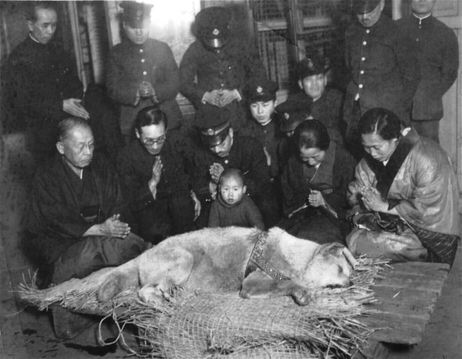
Hachiko's funeral
And yes, he had an actual funeral.
Hachikō was buried next to his master, and his fur was stuffed and made into a display for the National Science Museum of Japan. Even before his death, his loyalty was commemorated by a bronze statue of his likeness at the station; he was present for its unveiling. Though it was recycled for materials during the Second World War, a recreation was built in 1948 that remains standing today.

If this story sounds familiar to you, it's probably because there was a Richard Gere movie called Hachi and that episode of Futurama that always makes you cry, both of which took their inspiration from Hachikō. To this day, we recognize a little dog from Tokyo with statues, films and TV shows, all because he just couldn't stop loving someone, even after almost a decade of not seeing him.

Holy shit.

Wednesday, November 4, 2015

Holy Shit, James Harrison!

James Harrison with two babies

In 1951, a 14-year-old Australian kid named James Harrison underwent major chest surgery. There were no major complications, and he ended up fine, but it struck him as incredible that he required almost 3.5 gallons of donated blood in order to survive the ordeal. From that moment, he made a personal vow to donate as much blood as he possibly could once he had fully recovered. As soon as he turned 18, he started giving plasma every 2-3 weeks.

Which I guess was exhausting? This pictogram is weird.

Once he had one or two donations under his belt, there was an interesting development. It turns out James Harrison's blood contained an antibody called Rho(D) immune globulin. That probably doesn't mean much to you, but to OB/GYNs and medical researches, finding this antibody in someone who was vowing to donate as much blood as humanly possible was like planting a garden and finding El Dorado in your backyard as a result.
Muisca Raft Legend of El Dorado
I have a sudden urge to start gardening...in November.

To understand why, you need to know a bit about blood types and pregnancy complications. If a pregnant woman has a negative blood type but the fetus is positive, the mother's blood often treats the baby as a disease. The medical term for that situation is Rhesus Disease, but it's also known as "Bad News Bears." In the best case scenario, the baby is born anemic. More often than not, it could cause miscarriage or stillbirth.

Rhesus Disease used to be one of the most common causes of pregnancy and birth complications. But then James Harrison came around. When his fancy-pants antibody is given to pregnant women, it essentially hides the part of the baby's blood that causes the mother's body to treat it as a parasite. Thousands of babies were born and lived because Harrison was constantly donating. It wasn't long before researches developed RhoGAM, which is essentially a vaccine that protects at-risk pregnancies from Rhesus Disease.

James Harrison is still around and donating, and he's become a major voice for blood donation. He currently holds the world record for lifetime blood donations -- which, by now, is well over 1,000. It's estimated that his blood has saved over 2.4 million babies.
Crying newborn.
Well that's just ungrateful.

I don't usually get personal on this blog, but in this case I'm going to make an exception. My daughter is quite possibly alive today because of James Harrison. Her blood type is Rh positive and her mother's is Rh negative. My daughter is easily the single best thing that's ever happened to me. She's brought immeasurable happiness into my life, and I owe that happiness, in part, to James Harrison.
My foot and my baby's foot
There is nothing like this.

Holy shit.


By the way, you ought to consider donating blood yourself. You've got a ton of it, and it's not like you're using it all. Might as well, right? The Red Cross is a good place to start, but a quick Google search for "donate blood" should show you what your options are.


James Harrison with two babies. Australian Red Cross.

"Muisca raft Legend of El Dorado Offerings of gold" by Andrew Bertram - World66. Licensed under CC BY-SA 1.0 via Commons

"Human-Male-White-Newborn-Baby-Crying" by Evan-Amos - Own work. Licensed under Public Domain via Commons

Tuesday, February 10, 2015

Holy Shit, Viktor Tsoi!


On August 15th, 1990, a man in Latvia died in a car accident after falling asleep at the wheel. Within hours, the story was all over the Russian media, and a message was spraypainted onto a Moscow wall in all black that simply read, "Viktor Tsoi died today." Soon after, a separate message appeared, insisting, "Tsoi Lives!" The second message became something of a rallying cry for the Soviet and post-Soviet rock scene in Eastern Europe. Because Viktor Tsoi and his band, Kino, were the most important musical pioneers in Soviet history.

Kino rose to fame at a time when it was suddenly possible to criticize the communist regime in the USSR. In the 1980s, Glasnost and Perestroika became a thing and censorship started to wane. Kino was at the forefront of the new wave of artistic freedom. They took their inspiration from Western bands like The Smiths, R.E.M., and The Cure. At the height of their popularity, they released an album called Gruppa Krovi, or "Blood Type." The title track goes like this:


The chorus roughly means, "My blood type is pinned on my sleeve, and my number and rank. Wish me luck in the battles to come. Wish for me not to lay dead in the grass. Wish me luck in the battle." It's a protest song about the war in Afghanistan.
Mujahideen
The one where America was rooting for the Islamists
The band was just reaching its full potential when Viktor Tsoi died in the aforementioned car accident. Kino was in the midst of recording their highly anticipated eighth album. In fact, Tsoi was carrying a tape with him in the car that was the only copy of the recording of his vocal tracks for said album.


The crash was horrific. His car smashed into a bus and was all but disintegrated, and he died instantly. The tape not only survived, but it was entirely undamaged. Four months later, the album was released. Its cover was a mournful black with its title (KINO) in small white letters at the center. The name was quickly disregarded by fans, who dubbed it "The Black Album."
Kino
Where'd they get that idea?

The wall where "Tsoi Lives!" was written became a major cultural landmark in Moscow, and the phrase itself was repeated as something of a meme throughout Western Europe. It meat defiance in the face of grief. Rebellion in the face of loss. It was the new Russia. Or at least what the new Russia was supposed to be.
The Tsoi Wall
It's still there, too.

Holy shit.


"Victor Tsoi 1986 cropped" by Victor_Tsoi_1986.jpg: Igor Mukhinderivative work: Beaumain (talk) - Victor_Tsoi_1986.jpg. Licensed under CC BY-SA 3.0 via Wikimedia Commons

"Mortar attack on Shigal Tarna garrison, Kunar Province, 87" by Erwin Lux - Private collection; apparently a crop of this image at Flickr. Licensed under CC BY-SA 3.0 via Wikimedia Commons

"Кино, Черный альбом (Kino, Chyorny album) (1990)" by группа Кино - Чёрный альбом. Licensed under Public Domain via Wikimedia Commons

"Tsoi Wall 02" by Superchilum - Own work. Licensed under CC BY-SA 3.0 via Wikimedia Commons

Wednesday, January 21, 2015

Holy Shit, Uhura!


The woman in the above photo is Nichelle Nichols, in character as Lieutenant Nyota Uhura on the set of Star Trek. It's easy to forget (which is encouraging to me) how groundbreaking this character was for American fiction, and particularly for network television. She debuted with series opening episode, "The Man Trap," which aired in 1966.

Uhura was Chief Communications Officer aboard the Enterprise. That makes her the fourth link in the chain of command. So,..a black woman, in 1966, held a position of considerable power in a network television show. That's a mere two years after the Civil Rights Act. Deep-seated institutional racism doesn't just taper off that quickly. Uhura wouldn't have existed if Gene Roddenberry hadn't held downright shockingly progressive views for a man of his generation from Texas.
Gene Roddenberry
You wouldn't have known it by his face.

As a matter of fact, Roddenberry's original pilot featured a female First Officer, who was the intensely logical and level-headed presence on the bridge. The female character. In 1965. It goes beyond that, even. He stubbornly refused to allow any reference to organized religion as a going concern on the show. While working on The Next Generation, he told writer/producer Ronald D. Moore that he believed Earth's religions would taper out by the 23rd Century, to be replaced by personal spirituality.

But back to Uhura. At the end of the first season, Nichelle Nichols considered leaving to pursue a career on Broadway. One weekend, she went to a Civil Rights and met a big fan of the show who changed her mind. You may have heard of him, because he was Martin Luther King.

Junior.
Martin Luther King, Jr. giving his Dream Speech
Yeah. That Martin Luther King, Jr.
Dr. King told Nichols that Star Trek was the only show he and his wife allowed their kids to watch. He begged her not to leave, because he knew how important it was for black people in America, and in particular black women, to have a role model like Uhura. Someone who was not a servant of the heroes, but their peer. "Once that door is opened by someone," he said, "no one else can close it again.

So she stayed on for the duration of the series. It turns out, Dr. King was right on the money. Among those who called Nyota Uhura a major influence were Dr. Sally Ride, the first female astronaut, and Dr. Mae Jamison, the first black woman astronaut. Whoopi Goldberg, who played Guinan in The Next Generation, also looked up to Uhura. When she first saw Star Trek, she ran to her parents and shouted, "I just saw a black woman on television; and she ain't no maid!"

People make a big deal out of Star Trek, and we like to call those people nerds. But you can't deny the impact. It goes beyond launching a renewed interest in science fiction (and science in general). Star Trek played a crucial role in tearing down racist and sexist taboos, and it did so deliberately. Because Uhura's name? Comes from the Swahili, uhuru. Which means "freedom."

Holy shit.


"Gene roddenberry 1976" by Larry D. Moore. Licensed under CC BY-SA 3.0 via Wikimedia Commons - http://commons.wikimedia.org/wiki/File:Gene_roddenberry_1976.jpg#mediaviewer/File:Gene_roddenberry_1976.jpg

Wednesday, November 12, 2014

Holy Shit, the Cuban Missile Crisis!

Kennedy and McNamara
About a year and half ago, I shared the story of Stanislav Petrov, the Soviet Air Defense officer who saved the world by neglecting his duty...because at that moment his duty was to start a nuclear war. It may or may not surprise you to learn that, in the almost half-century time period where there was a terrifying standoff between nuclear powers, that wasn't the only time someone almost pushed the big red button.

In fact, there was one situation that was arguably a closer brush with the proverbial Midnight. That one you probably remember reading about. It involved Cuba. And missiles. And a crisis.
U2 Spyplane photos of the Cuban Missiles
And aerial reconnaissance photos that mean nothing to the untrained eye

The Cuban Missile Crisis started because Fidel Castro was sick of the CIA trying to topple his fledgling Communist nation, and Nikita Kruschev wanted to make the U.S. sweat. See, the so-called "missile gap" was an actual thing. But it was a thing that almost comically favored America. The Soviet Union really didn't even have the capability to strike most of the United States from a distance, whereas the United States had both a wealth of ICBMs and missile sites in Turkey, close enough to nuke the baldness off of the Soviet Premier.

So Kruschev sent some nukes to Cuba. When the U.S. noticed, the world started to figuratively explode with the fear that it would soon literally explode. The U.S. Joint Chiefs of Staff unanimously advised President Kennedy to invade Cuba. Let that sink in. Such a decision would absolutely, unequivocally guarantee that the U.S.S.R. would, at the very least, invade West Berlin. And that action would almost as certainly lead to a nuclear reprisal from NATO.
Reagan pointing at a nuclear explosion
Shit. Is. On. Fire.

In short, the U.S. Joint Chiefs of Staff were, with one voice, telling Kennedy that it was time to end the world. Kennedy thought maybe we should try a few other solutions first. The compromise was a naval "quarantine," which is like a blockade but you get to not use the word "blockade," because that's defined as an act of war by international law.

At some point, the ships of this blockade announced that they would be dropping practice depth charges on Soviet submarines. They weren't powerful enough to cause severe damage, but they would usually force a submarine to surface, negating its stealthy advantage. Somehow, the Soviet Foxtrot-class submarine B-59 didn't get the memo.
Message in a Bottle
I choose to believe it was the result of outdated communication methods.

When the depth charges hit, everyone aboard was under the impression that the Cuban Missile Crisis - and by extension, the Cold War - had just gone hot. That's where Vasili Arkhipov comes in. He was second-in-command on B-59, and he was one of three officers upon whose shoulders fell the decision of whether to fire a nuclear torpedo. The two other officers voted an emphatic "YES."

Arkhipov, thankfully, said "Well, I don't know." If he hadn't been a hero from a previous incident involving a nuclear accident at sea, his words may have been drowned out. But he stood his ground, and he had a reputation for being heard. B-59 surfaced, and Moscow informed them of the situation. The very next day, Kruschev announced that the missile sites were being removed, in exchange for assurances that the U.S. would not invade Cuba and, secretly, the removal of missile sites from Turkey.
Turkey
I mean, where were we even keeping them?

It's easy to think of the Cold War as a distant memory now. As a foregone conclusion. But we should remind ourselves once in a while that there were multiple occasions where a single voice of reason made the difference between continued detente and global annihilation. The Cold War was a game of Russian Roulette, and the Cuban Missile Crisis was the closest we ever came to pulling the trigger at the wrong time.

Holy Shit.

Wednesday, September 17, 2014

Holy Shit, It's That Guy! (The Hobbit Edition)

We're gonna do another one of these things, because it's fun and it's my blog and I'll cry if I want to. But I don't want to cry. I want to point out relatively obscure actors in high profile roles that you probably missed. Speaking of which, I missed one last time. Tywin Lannister, as it turns out, also makes a great movie-within-a-movie villain. Here he is being ridiculously evil in Last Action Hero:
Tywin Lannister in Last Action Hero
That glass eye doubles as a bomb. If that doesn't make you want to watch this masterpiece, you are dead inside.

Like last time, I'm going to ignore the bigger, more obvious ones. Yes, Martin Freeman was Arthur Dent, Ian McKellen was Magneto, Benedict Cumberbatch is a Benedict Sexybitch. Obviously.
Benedict Cumberbatch
I really am straight, I just call 'em like I see 'em

But what about humble Radagast the Hippie Brown?
Seen here making a mockery of his character

Did you notice that he's a freaking Time Lord?
Seventh Doctor
I'm not saying all the Istari are Time Lords, I'm just saying Gandalf kind of regenerated

How about this handsome fellow? Does he look familiar?
Azog the Defiler
And no, believe it or not, it's not your mom.
No?

What if you saw him with no prosthetics and no CGI...as you could when he played Marc Antony on Xena: Warrior Princess?
Marc Azogtany
He's not the only Xena alum in the cast. See if you can find the others!

Finally, one of my personal favorites. This guy, who sparked a bizarre sub-fandom when he first appeared in The Fellowship of the Ring:
Lindir
His official name is "Lindir," which is Elvish for "Singer."

...is none other than Bret McKenzie, the musician responsible for the rebooted Muppet Movie soundtrack. He's also one half of Flight of the Conchords, New Zealand's third most popular folk parody duo.
Flight of the Conchords
He's on the left. The other half is in the middle.

Holy shit, right? 

Let me know if I missed any good ones.

Wednesday, August 6, 2014

Holy Shit, Dracula!

Vlad III Dracula

When you get one of the most infamous monsters in all of storytelling named after you, you know you've done something right. Or wrong. Depends on how you respond to the whole "No such thing as bad publicity" adage. Posthumously. Very posthumously.

ANYWAY.

Squirrel
I shouldn't be getting off track this early.

Vlad III "Motherfucking" Țepeș was a Voivode (warlord) of Wallachia back around the time when the Byzantine Empire finally had enough with being the legacy of old Rome and rebelled via being utterly vanquished by the Ottomans. Wallachia, being a nearby neighbor of Constantinople, had its own problems with potential Ottoman invasion. Vlad's father, Vlad II, dealt with this threat pragmatically.

That is to say, he allied himself with Ottoman Empire, paid them tribute, sent his sons to them as hostages, and in return was installed as Voivode of Wallachia.This is after he joined a chivalric order called The Order of the Dragon, which was dedicated to fighting the "enemies of Christianity" -- chief among which were the Turks themselves.
White Flag
The best defense is a good mewling surrender.

As an aside: the Romanian word for "Dragon" is "Drac." Vlad II's association with The Order of the Dragon earned him the name "Vlad Dracul," or "Vlad the Dragon." I think you know where this is headed. Adding an "-a" to the end of a name makes it patronymic in this context. So Vlad III was also known as "Son of the Dragon," or "Dracula."

Vlad III's younger brother Radu got along famously with the Ottomans, and ended up converting to Islam. Vlad...not so much. He was constantly at odds with his captors, which meant he was constantly punished. This did nothing to improve the relationship. Eventually, his father and older brother were both killed, and Wallachia was taken over by a rival faction. The Ottomans' solution to this little problem was to install Dracula as Voivode.
Shit blowing up.
Which went thusly.

This didn't work out so well. First, because he was immediately overthrown. Then he came back and described to the usurpers all the vicious fantasies he had about just...straight up destroying Turks. And that pleased them enough to make him Voivode again. When Sultan Mehmed II sent envoys to his childhood playmate, Dracula responded by saying, "Hey, envoys, you didn't tip your hats to me when you came in. You must really like those turbans." Then he had their turbans nailed into their heads.

The Sultan was understandably a bit miffed by this turn of events. He sent an army under Hamza Bey to "make peace" with Wallachia and "remove" Vlad III if necessary. Vlad apparently caught Bey sleepin', though, and launched a surprise attack that killed or captured almost every single man under Hamza Bey's command. Then Vlad went to work earning the epithet Țepeș, or "the Impaler."

And boy howdy, did he ever work hard to earn it. The more squeamish readers might want to go ahead and stop here. It's about to get graphic up in this blog.

See, impalement is one of those execution methods that isn't meant to just kill you. It's meant to keep you alive until you really, really want to die. They'd grease a stake, stick you on it (and I'm gonna let you use your imagination as to where exactly they put you), and try to avoid rupturing any of your internal organs. In that way, you could live up to eight excruciating days in blinding, horrific pain before you finally died.

Vlad did this to about 1,000 of Hamza Bey's men, and to Hamza Bey himself. Then he brought small bands with him and, using the fluent Turkish language and customs he learned in his youth, waltzed into various Ottoman camps and put everyone within them to the sword. Or the stake.
Vlad Tepes and Impaled People
While Vlad treated himself to the steak.

Mehmed was displeased. He sent an army of almost 100,000 men in retribution, which Vlad the Impaler proceeded to dismantle and impale little by little over a series of stunning victories. Finally, it became too much. He was out of money, his mercenaries abandoned him, and he fled to Hungary where a rival imprisoned him.

For about a dozen years. Then he went back to Wallachia and took over again. Can't keep Dracula down. Or rather, you can. You just have to finally defeat him in battle to do it. Which is what happened about two months into his reign. The Turks brought his head back to Constantinople and everyone in the Ottoman empire changed their underpants and hoped no one like that would rise to power in the Balkans again.

Several hundred years later, an old writer named Bram Stoker was working on a vampire novel and came upon a tome that detailed some of the nastier figures in history. Vlad III Dracula turned out to be a perfect fit for the main villain, and the rest is pop culture history.
Bela Lugosi as Dracula
He's missing some of that Wallachian charm.


Holy shit.

Wednesday, July 23, 2014

Holy Shit, Minecraft!

Notch

That guy up there is Markus Persson, better known by his alias, "Notch." In May of 2009, Notch went to the forums of TIGSource, a meeting place for indie game developers and players. He'd been working on a new concept, inspired by Dwarf Fortress and Infiniminer, and he had a working build ready for feedback. It was rudimentary at best -- you had an infinite number of blocks and a small area to work in, and the point was to just...go to town building whatever you wanted.
Minecraft Classic
BUT WAT ABOUT MY GRAFIX?

But goddamn, was that promising. People got excited. They built statues, pixel art, the U.S.S. friggin' Enterprise, and whatever else came to mind. When they built something, they became proud and shared it with their friends. Word started to spread. This early version of Notch's vision came to be known as Minecraft Classic. Within a year, Indev (short for "in development") followed, bringing with it key features that would catapult Minecraft into the legendary role it plays today.
Minecraft 3x3 Crafting Grid
Like mining. And crafting.

I first learned of Minecraft around this time. I saw an introductory video from YouTube gamer SeaNanners, wherein he showcased the early crafting process. First, he punched a tree to get a log. Then, he used the crafting menu to turn the log into planks, which he used to build a crafting table. This gave him a 3x3 grid rather than a 2x2 grid. Then, he turned some of the planks into sticks, formed tools in the grid with sticks and planks, and I gasped aloud. The implications of this system were immediately apparent to me, and I purchased the game the moment the video ended.
Shut up and take my money
Artist's rendition

What Minecraft offers is nearly infinite creativity with a side of adventure. There are monsters, and you can deal with them by creating, not just taking what the developer gives you and clicking until they die. You build your base. You build your weapons. You build your armor. You mine your own resources. It's the purest form of a video game sandbox that has ever been. Word of the game spread like wildfire as players shared their creations and experiences.
Minecraft penises
Which, let's be honest, were inevitably phallic in nature.

Meanwhile, Notch quit his day job and formed a company called Mojang. Continued success meant he could hire more programmers to add features and hammer out bugs. Groundbreaking success meant he could hand over the reins to said programmers and start working on other projects.

When I say "groundbreaking," I want you to understand just how much I mean it. As of this month, Minecraft is the single best selling PC game of all time. It sold more than the notoriously addictive World of Warcraft. More than Starcraft, which launched an entirely new genre of spectator sports. Across all platforms, Minecraft (so far) is the third best selling video game of all time. It's behind Wii Sports (whose numbers aren't going anywhere anymore) and freaking Tetris. It's sold more copies that Super goddamn Mario Brothers, which was bundled with the NES (the system that singlehandedly pulled the game industry out of the abyss).
Minecraft pixel art
Nintendo's role is not lost on Minecrafters

Thanks to Minecraft, YouTube went from a hub of cat videos to a hub of Let's Play videos about Minecraft. It launched incredibly successful careers for people who now spend their days recording and editing their own gameplay videos. It is impossible to overstate just how monumentally Minecraft altered the gaming landscape. And it all started with just...a guy. For fun.

Holy shit.

Wednesday, June 25, 2014

Holy Shit, J. C. Penney

JCPenney

Ron Johnson was on the roll to end all roles in 2011. He was the man behind the Apple Store. He transformed computer sales from the darkly-lit fringe outfits of the '90s to the bright, minimalist, inviting atmosphere of today. In many ways, he made technology cool, and as a result he saw his bank account grow by some $400 million.

J. C. Penney, hungry for a hip new image, saw an enormous opportunity in Johnson. They brought him on as CEO in November of 2011 and tasked him with turning their tired old retail outfit into a hipster paradise of Apple proportions. So Johnson set to work.
Ron Johnson, JCP
"My ideas are big, you guys."

Step one: he hired a fellow Apple veteran as COO and fired a number of the stuffy old suits at JCP. He was taking the company in a new direction, and their input would be outdated.

Step two: he started courting hip brands, with the goal of redefining the type of person who shops at J. C. Penney.
Ron Johnson, JCP 2
"Seriously, though. Really big."

Step three: he took a jackhammer to the dishonest pricing policies of the old retail market. This was the big one. Standard practice in retail is to price everything on the high end, then have special discounts literally all the time to bring the price down to something that isn't exciting, but fair. Johnson wanted that to change. He repriced everything JCP carried to a lower, fairer price, then did away with constant coupons and specials.

It was a refreshing way for a CEO to look at business. He was keeping the actual, long-term interests of customers in mind. He was treating them like mature adults. Not children. Not sheep to be easily led astray by bright, flashy colors and big red lines through high dollar values and sunbursts with percentages in them. His ideas were truly visionary.
Ron Johnson, JCP 3
"Like, this big!"

And they failed harder than any ideas in the history of retail. I mean, they nearly ran J. C. Penney, a century-old institution, into the ground. As it turns out, people like instant gratification. They respond to it. They almost demand it. It makes them feel clever. When Johnson took that away from his customers, they took their business away from him.

J. C. Penney's stock price was cut in half during Johnson's tenure. Feedback from employees and customers alike was almost universally disdainful. After just over a year, he was removed from his position as CEO.
Ron Johnson, JCP 4
"Oh. Well, shit."

There are two lessons to be learned from this epic failure to market properly. The first is that retailers scam the shit out of you. Their sales practices are deceitful, and are based on the idea that you'll pay full price if you have a coupon pretending that "full price" is a discount. The second is that, if they didn't do these things all of these companies would die. Because we secretly like it.

Holy shit.

Wednesday, June 11, 2014

Holy Shit, Turing!

Alan Turing
I briefly mentioned Alan Turing in his capacity as a code breaker during World War II, but I didn't really elaborate. How about I do that now?

Turing was a goddamn genius. He had a mind that handled intricate logic the way most of us handle tying our shoes. During World War II, he helped build the framework for what would eventually become computers, and he did so in an effort to decode the German Enigma Machine. When his efforts paid off, he moved on to a more difficult version used by the Nazi navy, and he did that part himself. Because he felt like it.
Bombe
How hard could it be?

When the war ended, he decided to continue working on this newfangled "computer" idea, and it's largely because of that decision that you're reading this post today. At one point during his research, a strange question arose. He and his team were creating machines with stored memory. Machines that employed logic with relatively little input from users. The question was, "At what point can these machines be considered intelligent?"

And so the concept of realistic artificial intelligence was born. Turing even gave us a way to determine when we were approaching or crossing that threshold. He got the idea from a party game where two people would go out of sight and type answers to a series of questions, trying to imitate each other so that the rest of the group can't tell who's who.
Face/Off
The game was adapted into film in 1997

The Turing Test is like that, except one of the two players is not a human. The best way to go about it, Turing argued, would be to create a child-like computer then subject it to an education of sorts. And that's what people did. Chatter bots are all based on the principle of the Turing Test. They learn new tricks by talking to people. None of them have quite gotten the hang of it, though.

Well, until last week. At the University of Reading, a chatter bot named Eugene managed to convince a third of a panel of judges that it was a 13-year-old Ukrainian boy. Granted, there are some concerns about the methods, the judges, and the parameters. But the test itself was never a dichotomy so much as a general idea of where the fine line is between a machine and a mind. What Eugene tells us is that, while we might not have created a mind yet, we're very close.
Eugene Goostman
And it doesn't at all resemble the terrifying love child of Macauley Culkin and Heinrich Himmler

As for Turing, he became the victim of archaic moral legislation. Alan Turing was a gay man, which was not something you wanted to be in the United Kingdom back in his day. It was illegal for him to be who he was. One day, his house was robbed, so he called the police. It came out while they were interviewing him that he was in a relationship with a man. He was promptly arrested and convicted of "indecency." His punishment was a combination of probation and chemical castration, as well as the revocation of his security clearance. This effectively ended his career.

Two years later, Alan Turing imitated his favorite fairy tale (Snow White) by lacing an apple with cyanide and eating it, killing himself. And that's how Britain showed its appreciation for one of the greatest minds their country had ever produced. A mind that not only laid the groundwork for modern computer science, but saved countless lives by taking the enigma out of the Enigma machine. It only took them 55 years to apologize for the way they treated him. Then 4 more for the Queen to give him a pardon.

Holy shit.

Wednesday, June 4, 2014

Holy Shit, It's That Guy! (Game of Thrones Edition)

I'm gonna take a different approach today. I'm going to go all pop culture and throw educational value to the four winds. See, I've been watching Game of Thrones lately, and it keeps occurring to me that I've seen a lot of the characters before, often in surprising roles. Sometimes, the moment of anagnorisis makes me utter the sacred words of this blog, so I've decided to dedicate this post to those actors.

Here's the rules: It has to be a smallish role in something that was a pretty big deal back in its day. These rules are loosely defined and subjective. I just want everyone to know that I'm aware of that. Anyway...

What started me on this track was actually Buffy the Vampire Slayer, which I just recently started marathoning for the first time. Turns out it was way overdue. So, in the first episode of the fourth season, this awkward college freshman turns up, is promptly turned into a vampire, and is subsequently slain by the eponymous heroine:
Pedro Pascal in Buffy
This is what handsome looked like in the late '90s

He looked vaguely familiar, but I couldn't quite place him. Not three days later, Pedro Pascal did an AMA on Reddit wherein he mentioned that he had made an appearance on Buffy. If you're not sure who that is, just think of the sexiest Game of Thrones character you know. Whether you are male or female, gay or straight, the correct answer is:
Oberyn Martell being sexy
Speaks for itself.

Next up is Maester Pycelle, or "that perverted old prick in King's Landing." Here he is in the show:
Maester Pycelle, via HBO
Look at his stupid, smug little face.

And here he is piloting an AT-AT walker in the Battle of Hoth for The Empire Strikes Back:
General Veers on Hoth
Gotta hand it to him. He survived serving under Darth Vader. Few officers did.

And here he is choosing poorly in Indiana Jones and the Last Crusade:
Walter Donovan choosing poorly
"A cup for the King of Kings." Dumbass.

How about this guy:
The Hound
Essence of brooding distilled to a human face. After it's been set on fire, of course.

Surely he hasn't been in anything too big, right? He's such a memorable character, you'd know for certain if you'd seen him before. Right? Well, all I can say to that is, "Narp."
Yarp.
Yarp

That's him as the simple grocery boy Michael from Hot Fuzz. Maybe you would have recognized him if he had said more than one mangled word in the film.

This is fun. How about this guy? Joffrey Baratheon, First of his Name, spoiled little shit of a king, played by the only actor who has successfully made me want to stab a child in the face:

King Joffrey
Ugh. Just look at that face. It's begging to be knifed.

Well, here he is with Rachel Dawes during R'as al Ghul's attack on Gotham City in Batman Begins:

Jack Gleeson in Batman Begins
The fact that I don't even want to kick him a little bit is a testament to his acting chops.

I could go on and on like this. Catelyn Stark, for example, was Hermione's mom in the second-to-last
Harry Potter film. Jorah Mormont (aka General Friendzone) was in an episode of Doctor Who. There are so many characters in the series, you'd be hard pressed to not find one with a surprising career history. Let me know if I missed your favorite.

Holy shit. This was fun. I'll do more for other shows with big casts.