Showing posts with label history. Show all posts

Wednesday, May 18, 2016

Holy Shit, Hachikō!

Hachiko
Way back in 1924, a professor of agricultural studies named Hidesaburō Ueno at the University of Tokyo adopted a dog named Hachikō. Hachikō was a golden brown akita inu and, like many dogs, was reportedly a good boy, yes he was.

Ueno and Hachikō quickly developed an adorable daily routine. Every day, Ueno would say goodbye to Hachikō at his front door and go to work. Every evening, Hachikō had worked out, Ueno would arrive at the exact same time on a train at the nearby Shibuya Station. So Hachikō decided that Shibuya Station was a great place to be in the evenings. He showed up precisely when Ueno's train was due every single day, then excitedly greeted his master and walked him home.
Pre-war Shibuya Station
Shibuya Station looks like a dangerous spot for a dog to wait
Tragically, the budding familial relationship between Hachikō and Ueno was cut short in May of 1925, only about a year after it began. Professor Ueno suffered a fatal cerebral hemorrhage while at work and would never return to Shibuya Station. Hachikō waited for him for some time, then went home alone and presumably full of concern. The next day, he went back to the station at the same time, waited, and went home alone again.

He did the same thing the next day. Then the next day. Then the next. Somewhere along the way, Ueno's gardener adopted the dog as his own, but it did nothing to stop its routine. Every day, at the moment the evening train was due, Hachikō would appear at Shibuya station to wait for his old friend. Every. Single. Day.

Seven years later, Hirokichi Saito, one of Ueno's former students, recognized the dog when he happened to be at the station at the right time. He tailed Hachikō (no pun intended) to his home, where he met the gardener, who explained the whole story. Saito, deeply moved, published several articles about the dog's loyalty, holding it up as an example for all citizens of Imperial Japan to emulate.

One of these articles caught on in a big way, and suddenly Hachikō was a national sensation. Daily commuters brought treats for Hachikō, and people came to Shibuya Station specifically to see the famously loyal dog. All told, Hachikō visited the station every day for nine years, nine months and fifteen days. Finally, in March of 1935, Hachikō succumbed to cancer.
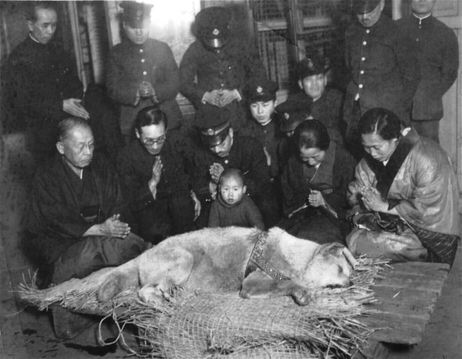
Hachiko's funeral
And yes, he had an actual funeral.
Hachikō was buried next to his master, and his fur was stuffed and made into a display for the National Science Museum of Japan. Even before his death, his loyalty was commemorated by a bronze statue of his likeness at the station; he was present for its unveiling. Though it was recycled for materials during the Second World War, a recreation was built in 1948 that remains standing today.

If this story sounds familiar to you, it's probably because there was a Richard Gere movie called Hachi and that episode of Futurama that always makes you cry, both of which took their inspiration from Hachikō. To this day, we recognize a little dog from Tokyo with statues, films and TV shows, all because he just couldn't stop loving someone, even after almost a decade of not seeing him.

Holy shit.

Wednesday, October 28, 2015

Holy Shit, the Battle of Hastings!

Harold's Death, Bayeux Tapestry

In January of 1066, the King of England, Edward the Confessor, died. He had become withdrawn and indecisive in his latter days, which led to three separate claims on the English throne: Harold Godwinson (who was crowned), Harald Hardrada of Norway, and William, the Duke of Normandy. All three had fairly legitimate claims to the throne, but Harold got to it first.

Not to be deterred, both Harald Hardrada and William assembled expeditionary forces and planned an invasion of England. Hardrada was faster (maybe because he was a Viking). With 300 ships and about 9,000 men, he landed in the north and quickly took the city of York. Unfortunately for him, he underestimated Godwinson's resolve.

Harold (with an O) raced north, gathering an army along the way, and caught Harald (with an A) unaware at Stamford Bridge in September. The element of surprise was present to the extent that about a third of the Norwegian army only showed up after the rest of them were in full rout. Of the 300 ships that came to England, only 24 returned to Norway, and none of them carried Hardrada.
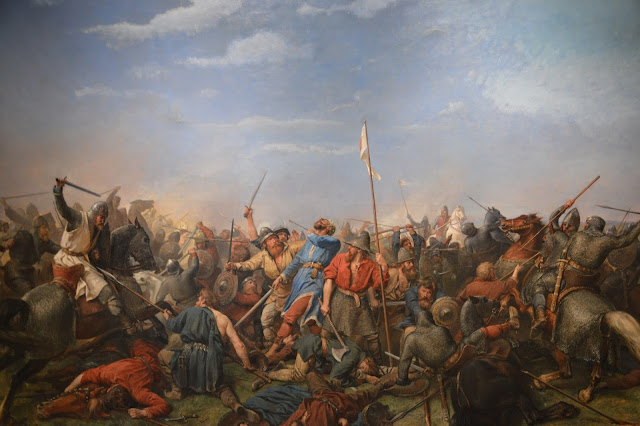
Battle of Stamford Bridge, Peter Arbo
That's him in the blue. He just got a new neck piercing. Ill-advised, as it turns out.
Harold Godwinson felt pretty good about that victory. For all of three days. In his furious march north, he had brought with him most of the levies that were meant to defend the south from William, which meant that when William landed there was pretty much no opposition. He built a small wooden castle at Hastings and started raiding the surrounding countryside.

After a grueling march and gruesome battle, Harold once again drove his forces across the country to meet an invader. Many of the details are unclear, but it appears that he favored speed over replenishing his forces. By the time he reached Hastings, his men were exhausted and battle-weary, and Norman scouts had spotted them, eliminating the element of surprise.
And coffee wouldn't even reach England for another several centuries!
Even so, the battle was far from one-sided. The English set up defensively on a hill, and the Normans repeatedly failed to dislodge them. At some point, a rumor started that William had been killed. Norman soldiers began to panic and run, which was ironically the spark that led to their victory. Foreign butts were mighty tempting to English swords, so the warriors holding them started breaking formations to reach them.

When William turned out to be alive -- and noticing the buttstabby lack of discipline -- he started using fake routs to shake loose the shield walls. While this didn't get the English off the hill, it did get them to expose their flanks, to which the Normans applied a liberal amount of charging horse. Things cascaded from there. the cavalry charge opened a path toward the King and his retinue, which led to the King's death, which sent the English into a full panic and essentially ended the battle right then and there.
Cavalry Charge, Bayeux Tapestry
And look! There were only like six of them!
Two months later, the Duke of Normandy was crowned King of England and given the name William the Conqueror. There were a few years of resistance but after Hastings England simply couldn't muster the strength to shake off the Norman Invasion. The consequences were staggering. The English aristocracy was systematically and thoroughly wiped out, replaced by William's vassals. Massive waves of refugees left England and settled elsewhere in Europe.

Even the English language was effectively destroyed by the Norman invasion. The kings of England for centuries after the Norman invasion spoke an old form of French, which gradually merged with English into a new Anglo-Norman dialect. That brings me to one of my favorite little tidbits of tangentially related history: Richard the Lionheart, arguably the most iconic Medieval King of England, never learned English.
And he certainly never learned a Scottish accent.
The Battle of Hastings is one of those rare moments in history where a few small decisions have a clear and massive impact on the rest of history for centuries to come. It was the deciding battle in the last successful invasion of England, almost a thousand years ago. It entirely broke England, reshaping it into something completely different, which has not been done to such a violent and rapid extent since.

Holy shit.


"A small cup of coffee" by Julius Schorzman - Own work. Licensed under CC BY-SA 2.0 via Commons

"Sean Connery in Robin Hood: Prince of Thieves" by Warner Brothers. Licensed under Fair Use

Wednesday, September 30, 2015

Holy Shit, Chloroform!


Despite being pretty much obsolete for its main intended use, chloroform maintains a solid foothold in our collective cultural awareness. And you know why. The trope of the chloroform-soaked rag has been so thoroughly woven into the fabric of crime fiction that it's the first thing we think of when we plan imagine a kidnapping.

What? There are perfectly legitimate reasons to wear a balaclava in late September.

In fact, it's such an integral trope that most of us will never even think about chloroform in any other context. Admit it, when you saw the title of this post you thought it was going to be all about kidnapping, didn't you? Well, you're not entirely wrong, but if you look closer at the history of chloroform, you'll find yourself in one of those situations where the rug gets pulled out from under you.

The problem with our kidnapping imagery is that chloroform doesn't work that way. Well it does, but not nearly that fast. You can rest easy with the knowledge that, were a criminal to approach you with a chloroform-soaked rag, he would have to hold it up to your face for five to ten solid minutes before you became unconscious.

Which means this scene is just starting to get awkward.

So where did the "Instant KO" myth come from? This guy:
Believe it or not, not a kidnapper.

That's Sir James Young Simpson, a Scottish obstetrician known for innovating new equipment and treatments to help advance the medical field. Simpson had a couple of colleagues over one day and decided to do a little experiment with some chloroform he happened to have. To make a long story short, the gathering ended up being a bit of a rager. His two human guinea pigs got first loopy, then giddy, then unconscious.

Simpson was thrilled with this discovery, and just three days later chloroform entered the medical scene as an anesthetic. His excitement at the relative speed with which his friends passed out led him to exaggerate a bit, which led the general public to believe that chloroform could cause instant sleepytimes. From there, writers (and disappointed criminals) took the ball and ran with it, and a trope was born.

As for its medical use, chloroform lost a bit of favor when it turned out that 1 in every 3,000 patients dosed with the drug ended up dead. Safer methods arose, especially nitrous oxide, and chloroform dropped out of the real world, taking refuge in fiction. Today, it's mostly used in chemistry labs or as a solvent.
Which is way less exciting.

So remember, if someone jumps from an alley and forces chloroform into your face, you're probably just going to end up a little frightened and a little high. At least from the drug, I make no further guarantees about the criminal.

Holy shit.


"Chickamauga 2009, Chloroform" by Kevin King - Flickr: Chickamauga 2009, Chloroform. Licensed under CC BY 2.0 via Wikimedia Commons

"Balaclava 3 hole black" by Tobias "ToMar" Maier. Licensed under CC BY-SA 3.0 via Wikimedia Commons

Still image from Charmed, S2E7: "Give Me a Sign"

"Simpson James Young signature picture" by Henry Laing Gordon - Frontispiece of Sir James Young Simpson and Chloroform (1811-1870). Licensed under Public Domain via Commons

"Senior chemistry lab at Mother's International School, Delhi" by Prateek Karandikar - Own work. Licensed under GFDL via Wikimedia Commons

Wednesday, January 21, 2015

Holy Shit, Uhura!


The woman in the above photo is Nichelle Nichols, in character as Lieutenant Nyota Uhura on the set of Star Trek. It's easy to forget (which is encouraging to me) how groundbreaking this character was for American fiction, and particularly for network television. She debuted with series opening episode, "The Man Trap," which aired in 1966.

Uhura was Chief Communications Officer aboard the Enterprise. That makes her the fourth link in the chain of command. So,..a black woman, in 1966, held a position of considerable power in a network television show. That's a mere two years after the Civil Rights Act. Deep-seated institutional racism doesn't just taper off that quickly. Uhura wouldn't have existed if Gene Roddenberry hadn't held downright shockingly progressive views for a man of his generation from Texas.
Gene Roddenberry
You wouldn't have known it by his face.

As a matter of fact, Roddenberry's original pilot featured a female First Officer, who was the intensely logical and level-headed presence on the bridge. The female character. In 1965. It goes beyond that, even. He stubbornly refused to allow any reference to organized religion as a going concern on the show. While working on The Next Generation, he told writer/producer Ronald D. Moore that he believed Earth's religions would taper out by the 23rd Century, to be replaced by personal spirituality.

But back to Uhura. At the end of the first season, Nichelle Nichols considered leaving to pursue a career on Broadway. One weekend, she went to a Civil Rights and met a big fan of the show who changed her mind. You may have heard of him, because he was Martin Luther King.

Junior.
Martin Luther King, Jr. giving his Dream Speech
Yeah. That Martin Luther King, Jr.
Dr. King told Nichols that Star Trek was the only show he and his wife allowed their kids to watch. He begged her not to leave, because he knew how important it was for black people in America, and in particular black women, to have a role model like Uhura. Someone who was not a servant of the heroes, but their peer. "Once that door is opened by someone," he said, "no one else can close it again.

So she stayed on for the duration of the series. It turns out, Dr. King was right on the money. Among those who called Nyota Uhura a major influence were Dr. Sally Ride, the first female astronaut, and Dr. Mae Jamison, the first black woman astronaut. Whoopi Goldberg, who played Guinan in The Next Generation, also looked up to Uhura. When she first saw Star Trek, she ran to her parents and shouted, "I just saw a black woman on television; and she ain't no maid!"

People make a big deal out of Star Trek, and we like to call those people nerds. But you can't deny the impact. It goes beyond launching a renewed interest in science fiction (and science in general). Star Trek played a crucial role in tearing down racist and sexist taboos, and it did so deliberately. Because Uhura's name? Comes from the Swahili, uhuru. Which means "freedom."

Holy shit.


"Gene roddenberry 1976" by Larry D. Moore. Licensed under CC BY-SA 3.0 via Wikimedia Commons - http://commons.wikimedia.org/wiki/File:Gene_roddenberry_1976.jpg#mediaviewer/File:Gene_roddenberry_1976.jpg

Wednesday, December 31, 2014

Holy Shit, the Walk to Canossa!

Walk to Canossa

Once upon a time, there was a Holy Roman Emperor named Henry IV. He wasn't a big fan of the Catholic Church having control over his business. In particular, he wanted to be able to assign his loyal subordinates as bishops within the Empire. Pope Gregory VII felt differently about the matter.

This all more came to a head when the two of them assigned separate candidates for the same position. Fuming, the Pope decided to push the big red button. The one marked "excommunicate." He notified Henry that he had exactly one year to prove that he's stopped being a dick about this whole investiture thing.
Pope Gregory VII
All while giving the "Oh no you didn't" finger wag
This being the year 1076, being excommunicated was a much bigger deal than it is today. Especially for a Holy Roman Emperor. His right to rule was, in the public perception, a divine mandate from god. To have God's corporeal press secretary declare him unfit to be a member of the church was a huge blow to his authority. Rebellion sprouted up across the Empire. Rebellion that had been growing underground among the aristocracy for some time...but now it had a religious excuse, so it burst to the surface.

So Henry had to do something. In the Winter of 1077, he got an entourage together in Speyer and headed South, away from Germany and across the Alps toward Canossa. Legend has it that he made the journey barefoot, wearing a cilice, braving frigid temperatures, snow, and ice the whole way. When he arrived, he found that the Pope ordered the gates closed. So he knelt in the snow.
Speyer to Canossa
And after the whole "uphill both ways" journey, too.
A blizzard raged outside, and Henry IV stayed. He ate nothing and wore little to ward off the snow. For three full days, he stayed outside the gate silently begging the church for forgiveness. It became clear to Gregory that to refuse Henry reconciliation with the church after that would be impossible. So he invited the Emperor inside, where they shared Communion.
Henry IV at Canossa
I mean, how could you not?
The Pope still didn't support Henry as Emperor, but the effects of the Walk to Canossa were long-term and far-reaching. During the Protestant Reformation, Henry's Walk was a rallying symbol for Protestants in Germany, who decided that their nation's rulers (and their nation itself) should never again have to face such humiliating submission to foreign powers, especially the Church. This same language was used by Adolf Hitler in his rise to power, against both the imagined conspiracy of the Jews and against government officials when the Nazi Party was banned.

Even today, people of many countries refer to a humiliating apology as their "Walk to Canossa." Just goes to show that a little hiking can do a lot for history and colloquial language.

Holy shit.

Wednesday, December 24, 2014

Holy Shit, NORAD!

Sears ad that got NORAD to track Santa

I've had this one in mind all year, specifically for today. Then NPR went ahead and did a story on it last week. Thanks, NPR. Thanks a lot.

For the uncultured rabble who don't follow NPR, I guess I can still give it a go. Around this time of the year in 1955, a local branch of Sears in Colorado Springs put an ad in the papers. The ad promised kids that they could get a hold of Santa Claus himself by calling a certain phone number. There was a bit of a typo, and when little Timmy picked up the phone on Christmas Eve to talk to Santa, a gruff military voice was on the other line. That gruff military voice belonged to a confused staffer of CONAD, which would be reorganized a few years later into NORAD. Nobody without security clearance was supposed to have that number.

You know NORAD, right? It's the North American Aerospace Defense Command. Aside from being terrible with acronyms, it serves the purpose of keeping unwanted visitors out of North American airspace. Unwanted visitors like Air Force planes that belong to nations who dislike America and Canada. Unwanted visitors like nuclear weapons.
Nuclear explosion
Which is pretty high on my list of things I don't want in my airspace.
It's obviously pretty nice to have them around. You would expect them to be a no-nonsense outfit. Strictly business, right? Well, for the most part, they are. The officer in charge that night, Colonel Harry Shoup, had a soft spot for good little American boys and girls. Since the cat was pretty much out of the bag where the phone number was concerned, he issued a standing order: When a staffer answers the phone to hear a child asking about Santa Claus, they are to perform their regular duty and track the flying object in U.S. airspace. That is to say, our nation's first line of air defenses was ordered to track Santa Claus on Christmas Eve and share his location with the children.
NORAD Tracking Santa
Military Decorum.

The feeling in general about this incident within the armed forces was that it was adorable. Adorable, and a perfect opportunity for good publicity. What better way to connect with the people they protect than to indulge in their most innocent fantasies? So it became a Thing with a capital T. Every year since 1955, CONAD -- and then NORAD -- has tracked Santa Claus on Christmas Eve and shared his location with inquiring children. It's all on a volunteer basis now, and there's a hotline and website and everything.

Because who says the people who watch the skies for nuclear missiles can't also get into the Christmas spirit?
NORAD Tracks Santa logo
Even if they could do better with the logo...
Holy shit.

Also, happy holidays.

Wednesday, December 17, 2014

Holy Shit, Hessy Taft!

Hessy Levinsons Taft

The baby above is Hessy Taft. Cute little bugger, isn't she?

Well, the Nazis certainly thought so. In 1935, the Nazi magazine Sonne ins Haus (The Sun in the House) had their own version of the "cutest baby contest" that magazines often have. Except they called theirs "The Most Beautiful Aryan Baby" contest. The chief judge was none other than Reich Minister of Propaganda Joseph Goebbles.
Joseph Goebbles
A considerably less handsome specimen.
Baby Hessy was taken to a photographer when she was a mere six months old. Without telling the parents, the photographer submitted the picture to the magazine, confident that he had found the prettiest baby in all the Third Reich. Goebbles agreed with him, and soon little Hessy's face was on the cover of the Nazi Magazine and plastered all over shop windows, magazine ads, and postcards throughout Germany.

You may already see where this is going. See, Taft is actually Hessy's married name. She was born Hessy Levinsons, and despite being renowned as a beautiful Aryan baby, she was, in fact, quite Jewish. The photographer explained to the family that he was ordered to submit his 10 favorite baby pictures to the contest, and he submitted the one he thought was most beautiful partly because he wanted to make the Nazi philosophy look ridiculous.
Which, as you might imagine, was not as easy back then.
Luckily for the Levinsons, the Nazi Party never realized they picked a Jewish baby as an example of what all good Aryan babies should look like. Even luckier, they escaped Germany after Hessy's father was captured by the Gestapo then released thanks to a good word from a Nazi he knew.

The cover photo of Hessy Taft is one of the most delicious pieces of irony I've ever seen. The Nazis were so authoritative, so certain of the pseudoscience behind their horrific racism...and yet here they were, failing at so basic a test of said pseudoscience as picking out a non-Jewish baby as a mascot.

Holy shit.

Wednesday, December 3, 2014

Holy Shit, Deir el-Medina!

Deir el-Medina Site

You won't find much in the way of functioning society at Deir el-Medina these days. It's just Northwest of the city of Luxor, next to the famous Valley of the Kings, just past the area where the Nile makes the ground fertile. What you will find, though, is plenty of evidence that people used to live there.

Deil el-Medina was a workers' village in New Kingdom Era Egypt. In case that doesn't mean anything to you, let me point out that the New Kingdom Era was 1550 and 1077 BC. Which is a hella long time ago.
Cleopatra and Julius Caesar
As old to Cleopatra as Cleopatra is us. Seriously.

It's placement was no accident. The workers who lived there were tasked with building the tombs of the Valley of the Kings. Thanks to painstaking excavations of the site during the 1920s, it's one of the clearest windows we have into the ancient Egyptian world.

Crucially, the surviving documents from the village were not preserved for posterity's sake, but rather by happenstance. That means that instead of self-aggrandizing tales of historical significance, Deir el-Medina gives us a glimpse into the ordinary daily life of the Ancient Egyptian worker.

We know, for example, that the village was what we might consider "middle class," and that the laborers there were mostly skilled tradesmen.We know that people worshiped both the "official" gods and their own "personal" gods, and that was pretty much okay with the authorities. We know that they practiced an eight day work week followed by a two day weekend. We know that they were allowed days off for both illness and hangovers. During their time off, some workers would build their own tombs - since, you know...they were pretty good at it.
Deir el-Medina worker's tomb
"Sick tomb, bro! Can't wait to see you in it!"

Maybe the most interesting thing we know about Deir el-Medina, though, is something that occurred during the reign of Ramesses III. Things weren't so hot for the Egyptian Empire at the time. In fact, the economic turmoil the Empire was embroiled in during that era was a significant factor in the overall decline of Egypt's influence.

What this meant for Deir el-Medina was that their wages and rations were late. This was a big no-no. A religious no-no, in fact. So, for the first (known) time in history, the workers went on strike. They refused to do any more work until the Pharaoh or Vizier came to speak with them about their wages and rations. Eventually, the authorities relented, but the process played out several times before it became clear that the workers were holding a winning hand.

That, as far as we know, is the origin of organized labor. In Egypt, over 3,000 years ago.

Holy Shit.

Wednesday, November 12, 2014

Holy Shit, the Cuban Missile Crisis!

Kennedy and McNamara
About a year and half ago, I shared the story of Stanislav Petrov, the Soviet Air Defense officer who saved the world by neglecting his duty...because at that moment his duty was to start a nuclear war. It may or may not surprise you to learn that, in the almost half-century time period where there was a terrifying standoff between nuclear powers, that wasn't the only time someone almost pushed the big red button.

In fact, there was one situation that was arguably a closer brush with the proverbial Midnight. That one you probably remember reading about. It involved Cuba. And missiles. And a crisis.
U2 Spyplane photos of the Cuban Missiles
And aerial reconnaissance photos that mean nothing to the untrained eye

The Cuban Missile Crisis started because Fidel Castro was sick of the CIA trying to topple his fledgling Communist nation, and Nikita Kruschev wanted to make the U.S. sweat. See, the so-called "missile gap" was an actual thing. But it was a thing that almost comically favored America. The Soviet Union really didn't even have the capability to strike most of the United States from a distance, whereas the United States had both a wealth of ICBMs and missile sites in Turkey, close enough to nuke the baldness off of the Soviet Premier.

So Kruschev sent some nukes to Cuba. When the U.S. noticed, the world started to figuratively explode with the fear that it would soon literally explode. The U.S. Joint Chiefs of Staff unanimously advised President Kennedy to invade Cuba. Let that sink in. Such a decision would absolutely, unequivocally guarantee that the U.S.S.R. would, at the very least, invade West Berlin. And that action would almost as certainly lead to a nuclear reprisal from NATO.
Reagan pointing at a nuclear explosion
Shit. Is. On. Fire.

In short, the U.S. Joint Chiefs of Staff were, with one voice, telling Kennedy that it was time to end the world. Kennedy thought maybe we should try a few other solutions first. The compromise was a naval "quarantine," which is like a blockade but you get to not use the word "blockade," because that's defined as an act of war by international law.

At some point, the ships of this blockade announced that they would be dropping practice depth charges on Soviet submarines. They weren't powerful enough to cause severe damage, but they would usually force a submarine to surface, negating its stealthy advantage. Somehow, the Soviet Foxtrot-class submarine B-59 didn't get the memo.
Message in a Bottle
I choose to believe it was the result of outdated communication methods.

When the depth charges hit, everyone aboard was under the impression that the Cuban Missile Crisis - and by extension, the Cold War - had just gone hot. That's where Vasili Arkhipov comes in. He was second-in-command on B-59, and he was one of three officers upon whose shoulders fell the decision of whether to fire a nuclear torpedo. The two other officers voted an emphatic "YES."

Arkhipov, thankfully, said "Well, I don't know." If he hadn't been a hero from a previous incident involving a nuclear accident at sea, his words may have been drowned out. But he stood his ground, and he had a reputation for being heard. B-59 surfaced, and Moscow informed them of the situation. The very next day, Kruschev announced that the missile sites were being removed, in exchange for assurances that the U.S. would not invade Cuba and, secretly, the removal of missile sites from Turkey.
Turkey
I mean, where were we even keeping them?

It's easy to think of the Cold War as a distant memory now. As a foregone conclusion. But we should remind ourselves once in a while that there were multiple occasions where a single voice of reason made the difference between continued detente and global annihilation. The Cold War was a game of Russian Roulette, and the Cuban Missile Crisis was the closest we ever came to pulling the trigger at the wrong time.

Holy Shit.

Wednesday, November 5, 2014

Holy Shit, Onfim!

Onfim 199

Remember when you were a kid, and you would fidget in all your classes and make weird doodles in your notebooks? Maybe you even still do it. It's a pretty common form of expression, usually reserved for when you can only spare about half your attention.

Onfim was a kid from Novgorod, Russia who doodled a lot. By itself, that doesn't mean much. But when Onfim was a student, Novgorod wasn't in Russia. It was the administrative center of the Novgorod Republic, which hasn't existed since 1478.
Novgorod Republic
I mean it was practically the size of Continental Europe. How am I just now learning about it?

We know about Onfim because he wrote his notes (and the aforementioned doodles) on soft birch bark. Before paper became a really big thing, birch bark was often used for that purpose. It's hearty and water-resistant, which is great for preservation since water is the mortal enemy of history.
Water
We'll beat you someday, water. You just wait.

Most of Onfim's writing involved practicing the Old Slavic alphabet and writing Psalms. The doodles, though, were likely not part of any assignment. He sketched portraits of himself, his friends, and his tutor. He drew fanciful monsters with arrows sticking out of them. He even drew pictures of knights in battle. I'm not sure which of those is the 13th Century equivalent of the Bond-Villain's-Underground-Bunker that every boy knows how to draw today, but I'm sure it's in there somewhere.
Onfim's sketches
I'm sure I've done something similar to this with helicopters instead of horses.

The great thing about Onfim is that he puts a human face on history. Not just a human face, but a face we all know. Because everybody doodles in school, and thanks to Onfim we know that we share that subtle desire to express ourselves with our ancestors going back at least 800 years.

Holy Shit.

Wednesday, October 29, 2014

Holy Shit, the Third Punic War!

Ruins of Carthage
 The Third Punic War started in 149 BC, and by 146 BC, Cato the Elder saw his dream of a dead Carthage fulfilled. If you were a Carthaginian at the time, the whole thing was just...such bullshit. You're sitting here in your utterly defeated country, doing whatever the Romans tell you to do because they could burn you and everything you love as easily as you could punch a rock.
Balancing Rock
Not that I'd recommend it. Rocks just aren't very good at dodging.

Then some foreign tribes started raiding Carthaginian territory. Carthage was bound by treaty to arbitrate all conflicts through the Roman Senate, but at this point they had paid off the war indemnity and considered the treaty dissolved. The Romans saw things differently.

More importantly, the Romans were facing a huge increase in population and a huge staying-the-same of farm yields. So the Third Punic War, essentially, was Rome looking at Carthage and saying, "Hey, guys, we need your food...so..." then lighting North Africa on fire.
Tunisian Painting
Not the farms, though. Boy, would that have ever been awkward!

Carthage was destroyed. Utterly. It's buildings were burned and its people put to the sword or sold into slavery. Its territories were annexed by Rome, and the city itself would only be rebuilt (as a Roman city) a century later. Then it became a Vandal Kingdom for a while until it was conquered by an Islamic Caliphate.

But here's the thing: when you completely obliterate a city, there's no one around to sign a peace treaty. In a weird but arguably (technically) legal way, the cities of Rome and Carthage remained at war after Carthage ceased to be part of the Empire. At least, that's how officials from both cities saw it in 1985, when the mayors of both cities signed a peace treaty and symbolic declaration of friendship.

If you take that technicality at face value, the Third Punic War was the longest conflict in history, lasting over 2,130 years.

Holy shit.

Wednesday, October 22, 2014

Holy Shit, The Cretaceous Coast!

Early Cretaceous Eath

We've got an election coming up in the United States. It's a midterm, which too many voters tend to think of like a bye week, but it's important. Go vote on November 4.

When you do, think about all the factors beyond your control that lead to the outcome of an election. Sometimes it's something stupid one of the candidates said or did to shoot themselves in the foot. Sometimes it's a wave of backlash against a single policy. And sometimes it's a 100-million-year-old geographic feature that used to be where you live.
Wait What?
I really hope some of you made this exact face.

That's the case for people living on the Cretaceous Coast, anyway. The Cretaceous Coast is, for the most part, a decidedly non-coastal region that stretches from Mississippi to the Carolinas. It's not easily distinguished on a modern topographical map, but in the Cretaceous Period it looked like this:
Late Cretaceous North America
This looks different from the one at the top of this post because they are millions of years apart
Pretty easy to see right? Well, you can also see it on a county-based electoral map, like this one from 2012:
Seriously though, look back and forth. It's eerie.

Now, I know what you're thinking. "Correlation isn't the same as causation, dummy," you sneer smugly as you sip your venti pumpkin spice latte and pat yourself on the back. Ordinarily, I'd agree with you. But not today. Today you're going to spit that pumpkin spice right back out onto your keyboard, you pretentious hipster. Because the Cretaceous Coast is demonstrably responsible for that strip of blue counties in the South.

Here's how it works: between 129 and 65 million years ago, the Cretaceous Coast was, in fact, a coast. That meant it was a hotbed of aquatic life, like plankton. When the water started receding, that life stayed behind and died, leaving a massive deposit of organic material. If you know anything about agriculture (and why wouldn't you in this day and age?), you know that organic material leads to ideal growing conditions for crops.
Human Reaper Larva
It can also be used to generate a representative of your race while all the actual humans are systematically destroyed.
Fast forward about 64,999,800 years to the early 1800s, and you've got yourself an agrarian, slave-based economy with nutrient-rich soil and an unprecedented boom in a cash crop (cotton) thanks to new industrial advances. The former Cretaceous Coast was primo real estate for plantation owners because it had some of the most hospitable soil on Earth for the humble cotton plant.

Not so hospitable for human rights, though
Now, I don't know if you were aware of this, but a lot of that cotton was actually picked by slaves. And at the time, chattel slavery was an institution that consisted almost entirely of white owners and black slaves. After the Civil War brought slavery to an end, most of those black slaves stayed where they were. Their families were there, and the only work many of them knew was there as well...and this time, they'd get paid to do it.

Eventually, those former slaves gained the right to vote. Some time later, they gained the actual ability to vote without being turned away at the polls or simply lynched for trying. Certain events transpired and certain party platforms were adopted, too complicated to go into here, that led to black voters almost universally voting for democrats in every election.

And that's how a geologic feature that hasn't been around since the dinosaurs continues to affect the political landscape of the American south to this very day.

Holy Shit.

And seriously, vote.

Wednesday, September 10, 2014

Holy Shit, the Confederate Flag!

Battle Flag of the Army of Northern Virginia

See that flag up there? Everybody knows what that flag is, right? Yeah. And everybody is wrong.

There are basically two camps where the Stars and Bars are concerned, and neither of them get it quite right. There's a third camp, of course, that is the correct one. It's full of historians and obnoxious pedants with blogs.
Me
Not that I'm naming names or anything

The first and more heinously incorrect camp is the one that says "It's heritage, not hate." They may well believe it, just as they (often, not always) believe that the civil war was fought over states' rights and not slavery.

Trouble is, the Southern states were only interested in states' rights as far as the states were supporting the institution of slavery. If it was a straight "limit the federal government" thing, the South would not have been so eager to pass the Fugitive Slave Act, which forbade Free States from granting free passage to escaped slaves.
Fugitive Slave Act
Also, it was total bullshit.

Don't get me wrong. The North didn't go to war to free the slaves. The North wanted to ensure that future states admitted to the Union were Free States, which had a lot more to do with congressional representation than any moral crusade. Ultimately, the Civil War was about whether States were legally allowed to leave the Union.

And the answer was, "Not according to my friend Richard Gatling over here."
Gatling Gun
He has 200 friends per minute agreeing with him, too.

The other camp maintains that the flag at the top of this page is the flag of the Confederacy, a nation that came into existence, according to its founding members, so that the institution of slavery could continue. They get part of it right. But it's not the flag of the Confederacy. The flag at the top of this page is the flag of the Army of Northern Virginia. There were three flags of the Confederate States of America, and they are below:
Flags of the Confederacy

The fact that we remember one region's battle standard as the flag is indicative of one of the reasons the Union won the Civil War. We'd already tried a Confederacy under the Articles of Confederation. It turns out, having a strong, centralized government is good for encouraging you to fight a war with the whole country in mind rather than just one region.

Since the Army of Northern Virginia was Robert E. Lee's army, it tends to get all the attention. Thus, we have everyone thinking their battle standard was the flag of the whole short-lived country. As for the flag representing a rebellion based on the right to treat people as property...well, yeah. It pretty much is that. But only in part of one of the states. So that's something, I guess.

Holy shit.