Wednesday, April 30, 2014

Holy Shit, Paul von Lettow-Vorbeck

Paul von Lettow-Vorbeck

I was, maybe, a bit too kind to Erwin Rommel when I wrote about him. He did some great deeds for a Nazi, but in the end he was, after all, a Nazi. Maybe he wasn't a model citizen in the modern, not-complicit-in-a-brutal-dictatorship sense of the word.

If you want an example of what a bold and decent person does against the rise of National Socialism, maybe a better choice would be Paul von Lettow-Vorbeck. Lettow-Vorbeck was a hero to the German people after World War I. He led the only successful invasion of Imperial British soil during that conflict, and he did so by waging what has been described as the greatest guerrilla operation in history.
Gorilla Operation
There are other contenders.

He led about 14,000 men in East Africa on a campaign that was meant solely to divert as much resources as possible away from the Allies on the Western Front. That way, he reasoned, the folks in the thick of the war could get the important fighting done. There was essentially no hope of success, and Lettow-Vorbeck proved it by surrendering entirely undefeated under orders from high command after the Armistice.

While he was in command, more than half of his men were native Africans. He lived in a different time -- when the White Man's Burden was considered progressive -- and yet, he showed a remarkable amount of tolerance and even respect for other races. He spoke fluent Swahili and named black soldiers as officers, a rarity at the time. When questioned, he firmly stated, "We are all Africans here."
Book of Mormon
A bunch of white kids would say the same thing years later in the Book of Mormon. The musical. Not the book.

After the war, Paul von Lettow-Vorbeck became involved in politics. He is chiefly known today as a vehement opponent of Adolf Hitler during his rise to power. He was one of Hitler's chief adversaries, and when the Führer offered him an ambassadorship as an olive branch in 1938, rumor has it that his response was, "Go fuck yourself." Imagine saying that to Hitler near the peak of his power. Even better, Lettow-Vorbeck's nephew was asked about the incident decades later, he said, "I don't think he put it that politely."
Andy from Parks and Rec
And everybody was like "OOOOOH YOU GOT SERVED MEIN FÜHRER!"

Pretty cool guy, right? Well, here's the thing: the guy was a major warhawk. He disobeyed direct orders by the governor of German East Africa in order to engage the British. The governor wanted to remain neutral in the war, because he rightly feared that war would destroy any positive change Germany brought to the region in favor of starvation and violence. That's exactly what happened, and Lettow-Vorbeck shrugged it off as an unfortunate fact of war. Add to that the fact that he regularly (albeit strategically) denied food to civilians so that his army could stay in the fight and he doesn't seem all that terrific.

That's the problem with heroes. They're all so human, and they all have to live in the real world.

Still, he told Hitler to go fuck himself. Major props for that one, right?

Holy shit.

Wednesday, April 23, 2014

Holy Shit, the New Coke!

New Coke can

Let's say you're a soft drink manufacturer. In fact, you're the biggest soft drink manufacturer in the world. You're on top of the world for almost a century, keeping a huge majority of the market for yourself. Life is good. Then suddenly, one of your chief rivals decides to try a new markeitng thing and actually prove that people prefer Pepsi to your smelly old Coke in blind taste tests.

That's the position in which the Coca-Cola company found themselves in the late 1970s and early 1980s. Pepsi had introduced the "Pepsi Challenge," where random people would participate in blind taste tests and regularly choose Pepsi over Coke. It was a devastating blow to morale at poor, folksy old Coca-Cola, and the sales figures weren't helping. Between 1940 and 1980, Coca-Cola's market share dropped from a comfortable 60% to a terrifying 24%.

Coca-Cola is doing pretty well for themselves
Pictured is (one of the buildings at) their rickety old mom-and-pop multinational corporate headquarters

So they sprang into action. The President of Coca-Cola and the VP of Marketing developed a radical rebranding strategy that would involve not only introducing a new, sweeter version of the famous beverage, but discontinuing the original. Enormous amounts of money went into meticulously crafting the new formula and taste testing it against both Pepsi and the old Coke. They called it Project Kansas.

Kansas being boring
If there's a better name for a project that would ultimately fail to excite anyone in a positive way, I haven't heard it.

And it won. Big time. It was poised to be the new favorite drink of the entire world. In 1985, they gave the green light. All at once, Coca-Cola stopped selling their old drink and launched the New Coke. If you or anyone you know was alive and cognizant during the 1980s, you know what happened next: a complete, unmitigated, cluster-fucking disaster.
Hindenburg disaster
Coca-Cola, April of 1985

It's not that people didn't like the taste of the New Coke. Research showed they liked it better than anything. It just wasn't Coke, dammit. There were some initial successes, but the backlash was outrageous. Coca-Cola's hotline saw a 200% increase in calls, almost all of which were people talking about the old formula as though their favorite uncle had just died. Some were depressed. Some were angry. Some even threatened to sue. After three months of this, the company finally decided to relent. They announced that the classic recipe would be making a triumphant return. The news was so celebrated that it was brought up on the floor of the in-session United States Senate.
Ted "I don't know how filibusters work" Cruz
And that was the last time anyone did something pointless, misguided, and stupid on the Senate Floor

Here's the part where I prove myself wrong. I called the disaster "unmitigated," but the re-release of the original recipe was actually a massive mitigation. People were so relieved to have their familiar product back that Coca-Cola surged ahead in the market once again. After a few months (and, notably, the release of Cherry Coke), Coca-Cola enjoyed twice the sales as Pepsi.

Little by little, the company put New Coke behind them. Sales in the United States were discontinued shortly after Coca-Cola Classic came back. A few years later, the New Coke was more or less gone. Finally, in 2009, the "Classic" label was removed, and the last vestige of the massive failure turned enormous success was gone.

To sum up: Pepsi, to most people, simply tastes better than Coke. But taste is almost insignificant compared to the power of familiarity and nostalgia.

Holy shit.

Wednesday, April 16, 2014

Holy Shit, the Frank Slide!

Frank just after the slide

The town of Frank in Alberta, Canada was founded in 1901 as part of the ever-growing network of railroad towns in the Pacific Northwest. The Canadian Pacific Railway, coupled with a nearby coal mine, made it a lucrative option for anyone who wanted to have...you know...work. And food. Those things were pretty important back then, as they are today.
Brioche
Although this was always an option. (I went pretty obscure on that joke)

This particular frontier town was located in the shadow of Turtle Mountain. I say was not only because the town was eventually moved, but also because so did the goddamn mountain. Very quickly, in fact. In less than two minutes in 1903, more than 90 million tons of the mountain moved...right on top of poor Frank. The event is known as the Frank Slide, and it was one of the costliest and deadliest landslides in recorded history.

In the months leading up to the Slide, coal miners reported seeing unusual fissures in the mines. The limestone inside the mountain was cracked, and the fissures allowed water through to further erode the rock, which led to a dangerously top-heavy mountain. Stir in a bunch of mining activities and you've got yourself a disaster brewing. It got to the point where the coal was practically mining itself when the mountain finally collapsed.
Minecraft Coal
Everyone agreed that it kind of took some of the reward out of the whole process

Somewhere around 600 people lived in Frank at the time of the landslide, and of them somewhere between 70 and 90 were killed. We don't know for sure, because only 18 bodies were ever found, and 6 of those were discovered years later by a crew building a road in what was probably the most terrifying manual labor they would ever perform. The actual number is probably a lot higher - there were about 50 people camping near the base of the mountain hoping to find work in the mines who weren't listed among the population of the town.

In the aftermath of the Slide, Sid Choquette got to thinking. Being a brakeman for the Canadian Pacific Railway, he had a pretty good idea of the train schedule. Checking his pocket watch and twirling his handlebar moustache worriedly (I assume), he realized that the Spokane Flyer a passenger train goddamn full of people, was overdue to arrive and had no way of knowing what had happened in Frank. The rails that were supposed to speed it along were, at this point, hindered by a two mile long pile of rubble. This is what can be referred to in layman's terms as really shitty conditions for a train ride.
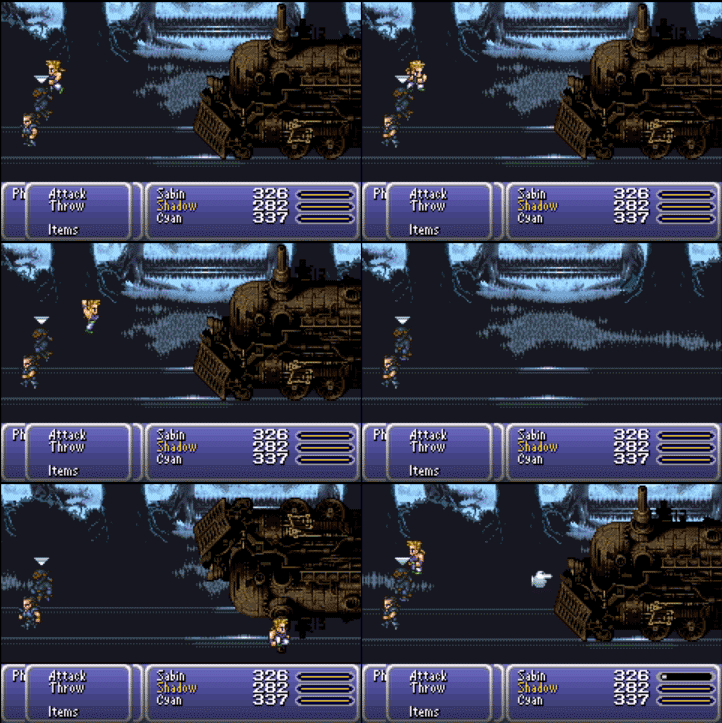
Sabin suplexing a train.
The only worse conditions would be "anywhere near Sabin."

So, ignoring the rubble and choking cloud of dust, Choquette ran over a mile without stopping and got the message to the approaching at literally the last possible second. His actions saved the lives of everyone on board the train, and the Canadian Pacific Railroad was so grateful they gave him...a kindly worded letter. And $25.
1898 Canadian dollar
CANADIAN.

You can see the results of the Frank Slide to this day:
Frank Slide Remains
That's mountain guts. That's what you're looking at. The guts of a mountain.

Holy shit.

Wednesday, April 9, 2014

Holy Shit, Damascus Steel!

Damascus Steel
Remember how the Byzantines basically invented napalm about a thousand years ago? Probably not, so follow the link and read about it. Go ahead, I'll wait.
Cookie Monster waiting
Take your time.

Pretty cool, huh? So, you know the part where we still don't quite know what Greek Fire was since it was a closely guarded military secret? That's sort of the same deal with Damascus steel.

Damascus steel swords were made primarily in the Middle East. Funnily enough, they did not originate in Damascus. Their name is the result of someone mishearing the word "damask," a type of weaving pattern that the metal's texture resembled.
Damascus steel dagger
Except, you know...stabbier

They were made from wootz steel out of India, and through some miraculous forging process they became incredibly sharp, as flexible as a yogi, and harder than mithril. Legend has it that a Damascus steel sword could cut a feather from the air then slice through armor like a hot machete through lightly curdled milk without losing any of its sharpness.

Around the mid-1700s, the rise of gunpowder and lengthy disruptions in trade from India eventually led to the loss of the swordsmithing techniques required to forge Damascus steel. They became a thing of legend. Then science happened.
Carbon Nanotubes
Pictured: Science. And it keeps changing directions. Watch. It'll freak you out.

While the technique for making it was lost, there were still some extant blades that historians and scientists could study. These have wielded some pretty interesting results, chief among which is that Damascus steel was reinforced by carbon nanotubes. Those weren't actually discovered, by the earliest reckoning, until 1952. It wasn't until the 1990s that we started making practical things out of them.

What I'm saying here is that as far back as 2000 years ago swordsmiths in the Middle East were literally (though probably unwittingly) using nanotechnology.

Holy Shit.

Wednesday, April 2, 2014

Holy Wombat Shit!

I'm going to make this exceptionally brief, for brevity is the soul of not-feeling-like-taking-the-effort-to-write-out-a-whole-blog-post-right-this-secondness. This is a wombat.
Vombatus ursinus
Yes you are, you cute little marsupial!

Yes. He is the cutest little doofus you can imagine. Now, here's his poo:
Wombat poop.
The logical next step.

It's square. It is a square poo. Wombats poop squares.

Why? Because the distinct shape helps to mark their territory, like a building block.

And it helps them identify potential mates, like that video you found in your uncle's special box when your parents weren't looking.

So, to recap: Wombats are adorable, but they're into square scat porn.

Holy cubic Shit.

Wednesday, March 26, 2014

Holy Shit, Shanties!

Have you ever seen a wild goose sailing on the ocean?
Wild Goose
Who hasn't these days?
If you answered "Ranzo, Ranzo Ray," (or some variation) you're probably very much familiar with sea shanties. Because that is one. And you're weird.

Sea shanties emerged around the 19th Century as a specific type of work song (though some theorize this was when they were revived from obscurity, not born). They were chiefly an English language phenomenon inspired in large part by African work songs. Just let that sink in for a second, considering the nature of the relationship between Europeans and Africans back then.
Inspection of a Slave
Oh, right. The travesties.

They existed because work on a sailing ship is difficult, laborious, repetitive, and requires a high degree of coordination. For example, to set sail on a square-rigged ship, you first need to hoist the yards. That requires a number of people pulling on ropes and pulleys in unison. All it takes is one or two people pulling at the wrong time to get the whole thing out of whack, which could delay departure or even endanger the crew.
Yards of the USS Columbus.
Not like it's confusing to have the same word mean a measurement, field, and part of a sail.


The traditional solution would be to have someone count out, "One, two, three," and have everyone haul on three. That worked well enough, but it was no fun. A better way, certain enterprising sailors decided, was to have a sort of foreman/lead singer, the shantyman, sing out a line or two and have everyone else sing the chorus. For example, when hoisting the yard, the song would go:
Shantyman: Our boots and shoes are all in pawn
Crew: Go down, you blood red roses, go down
Shantyman: Its flaming drafty 'round Cape Horn
Crew: Go down, you blood red roses, go down
On every "Go down," the crew would haul in unison. For a great example of this exact situation, watch the 1956 film Moby Dick. If you're the impatient type, just watch the part below. If you're especially impatient, just go straight to the 1:04 mark. As a bonus, you get "Heave Away Me Johnny" right afterward.


All the classic shanties were associated with certain types of work. "Drunken Sailor," the one you definitely know, was for continuous hauling work. Songs with longer verses would be used for raising the anchor, which involved circling around the capstan over and over to wind the rope. Some songs had extremely specific meanings.

"Leave Her, Johnny, Leave Her" was a pump shanty used for the last pump of a voyage -- thus, "Now those pumps are all pumped dry and it's time for us to leave her" means the water is all pumped back into the sea, and the sailors are free to disembark. There's a terrific note of ironic nostalgia in that one. It's about a voyage where everything was as bad as it can be on a sailing ship, but the minor key suggests that everyone is still sad to leave the awful ship behind.
Music can make any ship the Millennium Falcon

Well, the shanties may actually have something to do with that. Recent studies suggest that singing in unison with a group of other people actually makes everyone's hearts literally beat in unison. That sort of connection can't not be powerful, and it may help to explain the cohesiveness of a sailing crew and the pervasiveness of work songs throughout history. That's pure speculation, but it's not that far of a leap.

But that brings us to a problem. Where are our work songs today? When we do menial tasks with other people, we sit in relative silence. We chat sometimes. We even listen to music. But we don't have that quasi-mystical connection that songs can provide. Veteran sailors bemoaned the loss of the sea shanty with the rise of the steam engine, but what if it goes deeper than that? What if we're losing something critical to our innate understanding of the human condition by segregating music from everyday life?

I, for one, will be busy learning all the call-and-response work songs I can manage from now on. When my kids get to an age where putting them to work is reasonable (I'm thinking six months or so), they'll be singing bawdy songs all the while. According to science, that will bring us closer together.
Hauling a Halyard
DAD, WE DON'T EVEN HAVE A HALYARD.

Holy shit.

Wednesday, March 19, 2014

Holy Shit, Delta 32!

Because of the ribbon. And sexual transmission. That was an awful joke.

C-C Chemokine Receptor Type 5, or CCR5, is a protein in your white blood cells. We don't know its exact function, but we're pretty sure it interacts with T cells, and it may play a key role in inflammations that result from infection. All in all, it's a pretty standard white blood cell protein. That's what HIV counts on.

Some forms of HIV use CCR5 as their point of entry into your immune system. When that happens, shit gets bad. That's why most early drugs given to HIV positive people target CCR5. It's more or less the main point of entry for the AIDS virus.
Helm's Deep Grate
It's like that drainage grate at Helm's Deep. Only, you know, AIDS.

Now let's take a quick two and a half thousand year trip to the past and take a look at Ancient Athens. In 430 BC, the second year of the Peloponnesian War, Athens was struck with a massive, horrific plague that wiped out a fourth of its population. It was at this point in human history when CCR5 started to change. Medicine back then consisted mainly of blood-letting, the type of thing that lands you in a psyche ward nowadays. Back then you paid people to do it to you.

As a result, natural selection weeded out a lot of people via disease. Many survived, of course. Some of them had a bizarre natural resistance, which we now call CCR5-Δ32, or Delta 32. It's a gene mutation. A tiny variation in your genetic makeup that essentially deletes a certain segment of the CCR5 protein. As smallpox and various other diseases spread across Europe, the Delta 32 mutation became more common in the survivors, conferring various immunities to a lucky minority.
Anneken Hendriks the Anabaptist
Alas, this did not include immunity to ludicrous superstitious violence.

Today, Delta 32 is found in about 10-15% of European-descended humans. The segment of CCR5 that it deletes turns out to be a chief cause of all kinds of problems. That includes the aforementioned HIV. I suppose you can see what I'm getting at. If you are of European descent, there is as much as a 15% chance that you are, if not immune, then highly resistant to the AIDS virus.

That's evolution at work. Think of the untold thousands of people who had to die so that this mutation could become as prevalent as it is. Think of how many people would have to suffer today for it to become a common feature in human beings. This relatively new strength, like all the strengths we enjoy as a species, came at a massive cost over thousands of years.

Luckily, we've gotten pretty good at tinkering with evolution since then. Rather than opening our veins and hoping all the sick pours out with our blood, we use real science to develop real medicine that really works. And the discovery of the Delta 32 mutation is a boon for medicine. We don't know how, and we don't know for sure it'll work, but it's very possible that this natural resistance might hold the key to curing HIV, a disease that only twenty years ago was synonymous with a death sentence.

Holy shit.