Wednesday, May 28, 2014

Holy Shit, Memory (and Photography)!

Taking a picture with a phone

I think we can all agree that memory is weird. So weird, in fact, that I'm only going to focus on one aspect of memory in this post. It's a newly discovered thing that Neo-Luddites (now there's an oxymoron) have been bemoaning ever since cameras came with phones.

Pictures. That is, the incessant picture-taking of the kids-these-days generation. The kids these days traditionally respond by claiming that taking pictures helps them remember important events. "But sight is only one sense," the Neo-Luddites retort, "and you're so focused on taking pictures you forget to use the rest of your senses, or even actually see what you're recording."

"Pish-posh," say the youths, and they skateboard away full of mirth and truancy or whatever. I'm not really young anymore, I don't know.

Unicyclist
This came up when I googled "kids these days," so I guess it's possible that they've switched to unicycles

Well, the Neo-Luddites have new ammunition in their constant struggle against new and exciting things. Linda Henkel, a psychologist at Fairfield University, decided to find out whether of not they have a point through the clever use of science. It turns out they do.

Henkel sent a bunch of college students into an art museum and told them to photograph some pieces but just look at others. When they were quizzed later on, they were significantly more likely to remember small details if they hadn't taken a photo. Which means our brains really do subconsciously use photos as a memory crutch.
eggs frying
It's like that old drug PSA, but way less serious. And Rachel Leigh Cook isn't going to destroy your kitchen over it.

Before you Neo-Luddite readers get too excited, you should know that the rule is not absolute. When instructed to take photographs of specific details instead of an object as a whole, their memory was just fine. And that's not just on the detail they zoomed in on - zooming in on one detail made them as likely to remember all the details as students who took no pictures.

So next time you want to savor a moment, either savor it without the use of a camera or savor a few very specific details of it when you take a picture. Because otherwise your memory will partially shut down like the lazy young whippersnapper it is.


Holy shit.

Wednesday, May 21, 2014

Holy Shit, HIV.

The second I wrote the title of this post, I realized that I didn't want to make this topic funny. I can write about all kinds of promising research into a cure for HIV/AIDS. I can write about how much progress has been made in removing the stigma from both the virus and the gay community. But instead, I'll just tell you to look at this graph:


That's what HIV/AIDS has done to sub-Saharan Africa. It's effects, particularly in the late '80s, were downright apocalyptic. Young people are most susceptible. In the coldest possible terms, that means countries with major AIDS epidemics are deprived of a taxable work force. Which means they just can't afford to fix the problem.

Progress has been made, but we're a long, long way from recovering fully as a species from what HIV/AIDS has wrought. To this day, there are countries where one in four people are HIV positive. I honestly don't have the stomach to say much more than that. Maybe I'll revisit more specific elements later.

Holy shit.

Wednesday, May 14, 2014

Holy Shit, Flamethrowers!

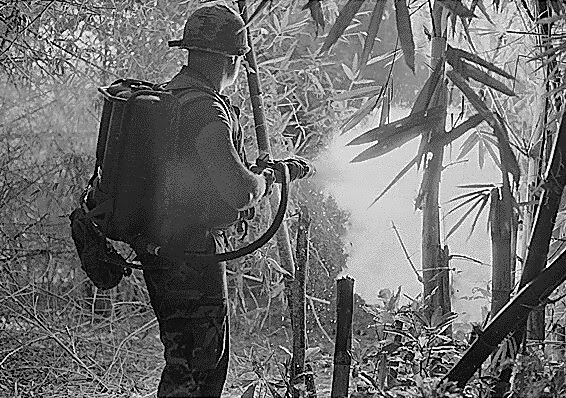
Flamethrower in Vietnam
According to George Carlin “The very existence of flamethrowers proves that some time, somewhere, someone said to themselves, 'You know, I want to set those people over there on fire, but I'm just not close enough to get the job done.'” If you don't count the Byzantine Empire (and who does these days?), that someone was probably Richard Fiedler.

Fiedler submitted his designs for a man-portable horrific weapon that spits goddamn fire at people to the German army in 1901, and he called it the Flammenwerfer. What with being German and all. It was first used in combat in World War I, where it was used to cleverly employ man's subtle fear of dying horribly in a fiery inferno, making soldiers run out into the open. That was not such a good thing to do in Trench Warfare.
No Man's Land
They didn't call it "No Man's Land" because it was a ladies-only club.

They were used much more extensively in World War II, where both the Axis and the Allies learned that throwing fire into a building was actually a really handy trick for murdering everything inside. The U.S. found them particularly useful in the Pacific Theater, where they could belch the white hot fury of Hades into caves and thick vegetation, burning down the later and sucking all the oxygen out of the former. The only drawback was a mild concern that the person carrying the weapon was essentially an incendiary bomb at all times.

Man on fire
Which I guess is a pretty big deal to some people

As of 1978, the U.S. military stopped all use of flamethrowers in combat. It turns out they're not actually all that effective on the battlefield. At least, not effective enough to justify the public relations problem that results from causing horrific, burning, largely indiscriminate death. Not to worry, though! The flamethrower has more uses!

We'll start with the positive one. Remember how Smokey Bear was wrong about forest fires? Well, it turns out that the best way to do a controlled burn and prevent out-of-control wildfires involves flamethrowers. Neat, huh? It gets better!
Controlled Burn
Better than public works projects? Impossible!

In the good old United States of America, flamethrowers are almost completely unregulated on a federal level! In many states, you can either purchase or build your own flamethrower and use it for whatever purpose you want! Other than killing folks. We do have laws for that. But if you think a flamethrower is necessary for your personal protection against home invaders, you are within your rights to have one under your pillow. Criminals will regret ever breaking into your house. And your house will probably burn to the ground.

But that's nothing compared to what I see as the pinnacle of flame propelling technology. In South Africa, starting in 1998, car-mounted flamethrowers were available as a defensive measure against car jacking. Someone trying to break into your car? No problem! Set them on fire!
Car-mounted flamthrower
I'm not seeing any way this could go horribly wrong.

They've since discontinued that particular product line, so now South Africans have to settle for personal pocket flamethrowers for self defense. Which are available in stores. Over the counter.

Holy shit.

Wednesday, May 7, 2014

Holy Shit, the Birthday Song!

The traditional English birthday greeting


This is my 100th post on this here blog. To celebrate, I'd like to lead a rousing chorus of "Happy Birthday to You." But I can't. And it's not because a blog is an inanimate series of 1s and 0s hosted on a data server and transferred via a series of tubes to your monitor. Nor is it because a chorus requires people to be in the same room, and Internet communication requires no such thing.

Picasso's "Old Guitarist"
That would affect the logistics a little bit, though. And make it lonelier.

It's because "Happy Birthday to You" is copyrighted, and it has been since 1935. If you've ever wondered why family restaurants all have their own terrible, awkward birthday songs, this is why. Warner/Chappell Music owns the rights to the song, and they absolutely insist that anyone who sings it in a way that can be construed as "for profit" must send them a generous royalty check. Almost like a...birthday present?

Crickets.
OH COME ON, GUYS, I'M PRACTICING MY DAD JOKES

This is one of those things you're going to start noticing all the time now that you know it. Whenever it's someone's birthday in a film or on television, they'll typically either cut the song off after a few words so that they can claim fair use, invent their own song a la family restaurants, or resort to the archaic but public domain "For He's a Jolly Good Fellow."

Don't worry, there's hope. Warner/Chappell Music is facing a class-action lawsuit that, if the plaintiffs prevail, will set "Happy Birthday to You" squarely in the public domain beside its older, British-er companion. Until then, you might want to avoid singing it unless most of the people around you are family or friends. Because they absolutely will sue your pants off. And why wouldn't they? The company rakes in $5,000 per day just by enforcing their copyright.

Holy shit.

Wednesday, April 30, 2014

Holy Shit, Paul von Lettow-Vorbeck

Paul von Lettow-Vorbeck

I was, maybe, a bit too kind to Erwin Rommel when I wrote about him. He did some great deeds for a Nazi, but in the end he was, after all, a Nazi. Maybe he wasn't a model citizen in the modern, not-complicit-in-a-brutal-dictatorship sense of the word.

If you want an example of what a bold and decent person does against the rise of National Socialism, maybe a better choice would be Paul von Lettow-Vorbeck. Lettow-Vorbeck was a hero to the German people after World War I. He led the only successful invasion of Imperial British soil during that conflict, and he did so by waging what has been described as the greatest guerrilla operation in history.
Gorilla Operation
There are other contenders.

He led about 14,000 men in East Africa on a campaign that was meant solely to divert as much resources as possible away from the Allies on the Western Front. That way, he reasoned, the folks in the thick of the war could get the important fighting done. There was essentially no hope of success, and Lettow-Vorbeck proved it by surrendering entirely undefeated under orders from high command after the Armistice.

While he was in command, more than half of his men were native Africans. He lived in a different time -- when the White Man's Burden was considered progressive -- and yet, he showed a remarkable amount of tolerance and even respect for other races. He spoke fluent Swahili and named black soldiers as officers, a rarity at the time. When questioned, he firmly stated, "We are all Africans here."
Book of Mormon
A bunch of white kids would say the same thing years later in the Book of Mormon. The musical. Not the book.

After the war, Paul von Lettow-Vorbeck became involved in politics. He is chiefly known today as a vehement opponent of Adolf Hitler during his rise to power. He was one of Hitler's chief adversaries, and when the Führer offered him an ambassadorship as an olive branch in 1938, rumor has it that his response was, "Go fuck yourself." Imagine saying that to Hitler near the peak of his power. Even better, Lettow-Vorbeck's nephew was asked about the incident decades later, he said, "I don't think he put it that politely."
Andy from Parks and Rec
And everybody was like "OOOOOH YOU GOT SERVED MEIN FÜHRER!"

Pretty cool guy, right? Well, here's the thing: the guy was a major warhawk. He disobeyed direct orders by the governor of German East Africa in order to engage the British. The governor wanted to remain neutral in the war, because he rightly feared that war would destroy any positive change Germany brought to the region in favor of starvation and violence. That's exactly what happened, and Lettow-Vorbeck shrugged it off as an unfortunate fact of war. Add to that the fact that he regularly (albeit strategically) denied food to civilians so that his army could stay in the fight and he doesn't seem all that terrific.

That's the problem with heroes. They're all so human, and they all have to live in the real world.

Still, he told Hitler to go fuck himself. Major props for that one, right?

Holy shit.

Wednesday, April 23, 2014

Holy Shit, the New Coke!

New Coke can

Let's say you're a soft drink manufacturer. In fact, you're the biggest soft drink manufacturer in the world. You're on top of the world for almost a century, keeping a huge majority of the market for yourself. Life is good. Then suddenly, one of your chief rivals decides to try a new markeitng thing and actually prove that people prefer Pepsi to your smelly old Coke in blind taste tests.

That's the position in which the Coca-Cola company found themselves in the late 1970s and early 1980s. Pepsi had introduced the "Pepsi Challenge," where random people would participate in blind taste tests and regularly choose Pepsi over Coke. It was a devastating blow to morale at poor, folksy old Coca-Cola, and the sales figures weren't helping. Between 1940 and 1980, Coca-Cola's market share dropped from a comfortable 60% to a terrifying 24%.

Coca-Cola is doing pretty well for themselves
Pictured is (one of the buildings at) their rickety old mom-and-pop multinational corporate headquarters

So they sprang into action. The President of Coca-Cola and the VP of Marketing developed a radical rebranding strategy that would involve not only introducing a new, sweeter version of the famous beverage, but discontinuing the original. Enormous amounts of money went into meticulously crafting the new formula and taste testing it against both Pepsi and the old Coke. They called it Project Kansas.

Kansas being boring
If there's a better name for a project that would ultimately fail to excite anyone in a positive way, I haven't heard it.

And it won. Big time. It was poised to be the new favorite drink of the entire world. In 1985, they gave the green light. All at once, Coca-Cola stopped selling their old drink and launched the New Coke. If you or anyone you know was alive and cognizant during the 1980s, you know what happened next: a complete, unmitigated, cluster-fucking disaster.
Hindenburg disaster
Coca-Cola, April of 1985

It's not that people didn't like the taste of the New Coke. Research showed they liked it better than anything. It just wasn't Coke, dammit. There were some initial successes, but the backlash was outrageous. Coca-Cola's hotline saw a 200% increase in calls, almost all of which were people talking about the old formula as though their favorite uncle had just died. Some were depressed. Some were angry. Some even threatened to sue. After three months of this, the company finally decided to relent. They announced that the classic recipe would be making a triumphant return. The news was so celebrated that it was brought up on the floor of the in-session United States Senate.
Ted "I don't know how filibusters work" Cruz
And that was the last time anyone did something pointless, misguided, and stupid on the Senate Floor

Here's the part where I prove myself wrong. I called the disaster "unmitigated," but the re-release of the original recipe was actually a massive mitigation. People were so relieved to have their familiar product back that Coca-Cola surged ahead in the market once again. After a few months (and, notably, the release of Cherry Coke), Coca-Cola enjoyed twice the sales as Pepsi.

Little by little, the company put New Coke behind them. Sales in the United States were discontinued shortly after Coca-Cola Classic came back. A few years later, the New Coke was more or less gone. Finally, in 2009, the "Classic" label was removed, and the last vestige of the massive failure turned enormous success was gone.

To sum up: Pepsi, to most people, simply tastes better than Coke. But taste is almost insignificant compared to the power of familiarity and nostalgia.

Holy shit.

Wednesday, April 16, 2014

Holy Shit, the Frank Slide!

Frank just after the slide

The town of Frank in Alberta, Canada was founded in 1901 as part of the ever-growing network of railroad towns in the Pacific Northwest. The Canadian Pacific Railway, coupled with a nearby coal mine, made it a lucrative option for anyone who wanted to have...you know...work. And food. Those things were pretty important back then, as they are today.
Brioche
Although this was always an option. (I went pretty obscure on that joke)

This particular frontier town was located in the shadow of Turtle Mountain. I say was not only because the town was eventually moved, but also because so did the goddamn mountain. Very quickly, in fact. In less than two minutes in 1903, more than 90 million tons of the mountain moved...right on top of poor Frank. The event is known as the Frank Slide, and it was one of the costliest and deadliest landslides in recorded history.

In the months leading up to the Slide, coal miners reported seeing unusual fissures in the mines. The limestone inside the mountain was cracked, and the fissures allowed water through to further erode the rock, which led to a dangerously top-heavy mountain. Stir in a bunch of mining activities and you've got yourself a disaster brewing. It got to the point where the coal was practically mining itself when the mountain finally collapsed.
Minecraft Coal
Everyone agreed that it kind of took some of the reward out of the whole process

Somewhere around 600 people lived in Frank at the time of the landslide, and of them somewhere between 70 and 90 were killed. We don't know for sure, because only 18 bodies were ever found, and 6 of those were discovered years later by a crew building a road in what was probably the most terrifying manual labor they would ever perform. The actual number is probably a lot higher - there were about 50 people camping near the base of the mountain hoping to find work in the mines who weren't listed among the population of the town.

In the aftermath of the Slide, Sid Choquette got to thinking. Being a brakeman for the Canadian Pacific Railway, he had a pretty good idea of the train schedule. Checking his pocket watch and twirling his handlebar moustache worriedly (I assume), he realized that the Spokane Flyer a passenger train goddamn full of people, was overdue to arrive and had no way of knowing what had happened in Frank. The rails that were supposed to speed it along were, at this point, hindered by a two mile long pile of rubble. This is what can be referred to in layman's terms as really shitty conditions for a train ride.
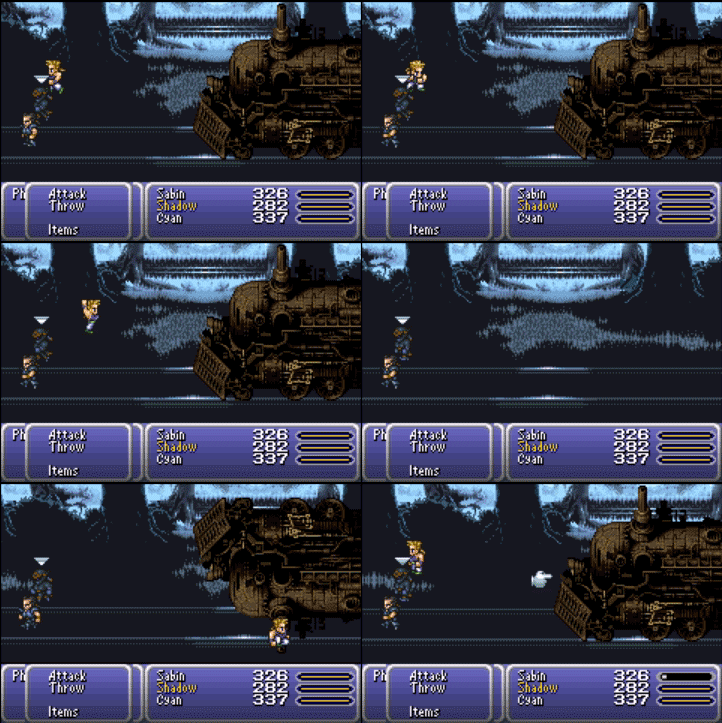
Sabin suplexing a train.
The only worse conditions would be "anywhere near Sabin."

So, ignoring the rubble and choking cloud of dust, Choquette ran over a mile without stopping and got the message to the approaching at literally the last possible second. His actions saved the lives of everyone on board the train, and the Canadian Pacific Railroad was so grateful they gave him...a kindly worded letter. And $25.
1898 Canadian dollar
CANADIAN.

You can see the results of the Frank Slide to this day:
Frank Slide Remains
That's mountain guts. That's what you're looking at. The guts of a mountain.

Holy shit.